
Last updated: 11 October 2026
Cherry blossom season in Japan is not one date. The flowers open in Okinawa in January, reach Tokyo, Kyoto and Osaka in late March, and finish in Sapporo around the start of May. The official 2027 forecasts are not out yet: on 11 October 2026 nobody can tell you the day Tokyo's trees will open next spring. What we can give you is the long-term average for each city from the Japan Meteorological Agency (JMA), how far real years stray from it, and how to plan a trip from the US, the UK or Australia around that. We will update this guide when the 2027 forecasts are published.
Cherry blossom 2027 at a glance
| Details | Status on 11 October 2026 | |
|---|---|---|
| Okinawa | Mid-January to early February (a different, earlier cherry) | 30-year average below |
| Kyushu, Tokyo, Kyoto, Osaka | Late March to early April | 30-year average below |
| Kanazawa and Sendai | Early to mid-April | 30-year average below |
| Hakodate and Sapporo | Late April to early May, around Golden Week | 30-year average below |
| Official 2027 forecasts | Japan Meteorological Corporation, Weathernews, tenki.jp | Not yet published. The first 2026 forecasts came out between mid-December 2025 and early January 2026 |
| Main airports | Narita (NRT) and Haneda (HND) for Tokyo, Kansai (KIX) for Kyoto and Osaka, New Chitose (CTS) for Sapporo | Our arrival guides linked below |
When the blossoms open: the 30-year averages
JMA records two dates at each of its weather stations, by watching one chosen "sample tree" (Tokyo's is at Yasukuni Shrine):
- First bloom (kaika): the first day five or six flowers are open on the sample tree.
- Full bloom (mankai): the first day about 80% or more of the buds are open.
Full bloom is the date to plan around. The trees usually look their best from full bloom for about a week, until rain or wind brings the petals down. The table gives JMA's normal dates, the average over 1991 to 2020, with what actually happened in spring 2026 beside them (JMA first-bloom table, JMA full-bloom table).
| City | Average first bloom | Average full bloom | 2026 first bloom | 2026 full bloom |
|---|---|---|---|---|
| Naha (Okinawa) * | 16 January | 4 February | 18 January | 3 February |
| Fukuoka | 22 March | 31 March | 24 March | 3 April |
| Hiroshima | 25 March | 3 April | 19 March | 30 March |
| Tokyo | 24 March | 31 March | 19 March | 28 March |
| Nagoya | 24 March | 2 April | 17 March | 30 March |
| Kyoto | 26 March | 4 April | 23 March | 30 March |
| Osaka | 27 March | 4 April | 26 March | 3 April |
| Kanazawa | 3 April | 8 April | 29 March | 3 April |
| Sendai | 8 April | 13 April | 31 March | 4 April |
| Aomori | 22 April | 26 April | 13 April | 16 April |
| Hakodate | 28 April | 2 May | 18 April | 20 April |
| Sapporo | 1 May | 6 May | 18 April | 24 April |
* JMA observes the Somei Yoshino cherry, the pale pink tree of most hanami photos, everywhere in this table except Okinawa, where it observes the deep pink Kanhizakura (hikanzakura in JMA's tables). That is why Okinawa blooms two months earlier.
Two things stand out. First, real years move a lot: Tokyo's first bloom has fallen anywhere from 14 March (2021 and 2023) to 29 March (2024) in the last six years. Second, recent springs have run early, most of all in the north. In 2026 Sapporo reached full bloom on 24 April, twelve days before its average. So treat the averages as the middle of a range, not a promise.
When the 2027 forecasts come out
JMA stopped publishing its own cherry blossom forecast years ago. Three private forecasters publish one now:
- Japan Meteorological Corporation (Nihon Kisho), which released its first 2026 forecast in mid-December 2025 and updated it through the spring.
- Weathernews, whose first 2026 forecast came out on 8 January 2026 (Weathernews).
- tenki.jp, run by the Japan Weather Association.
If they keep to the same timetable, the first 2027 forecasts should appear between mid-December 2026 and January 2027, with updates every week or two into March. The early ones can shift by several days. We will add the 2027 forecast dates to this guide as soon as they are published. If you are booking flights before then, aim for the average full-bloom date of your main city and allow a few days either side.
Planning a route around the bloom
Because the bloom travels north, one trip can catch it more than once:
- Late March to early April: Fukuoka, Hiroshima, Tokyo, Nagoya, Kyoto and Osaka all reach full bloom within about a week of each other on average. This is the classic trip, and the busiest.
- Early to mid-April: Kanazawa and Sendai are usually a week or so behind Tokyo, so a late start still finds trees in flower.
- Late April to early May: Hakodate and Sapporo. A Hokkaido trip at the end of April can be a second chance if you missed the south.
Within a city, some trees bloom later than the Somei Yoshino. In Kyoto, the weeping cherries in Heian Shrine's garden reach full bloom a few days after the others, and Ninnaji's Omuro cherries about a week after (japan-guide.com). Arriving a little late is less of a loss than it looks.
Where to see cherry blossoms in Tokyo
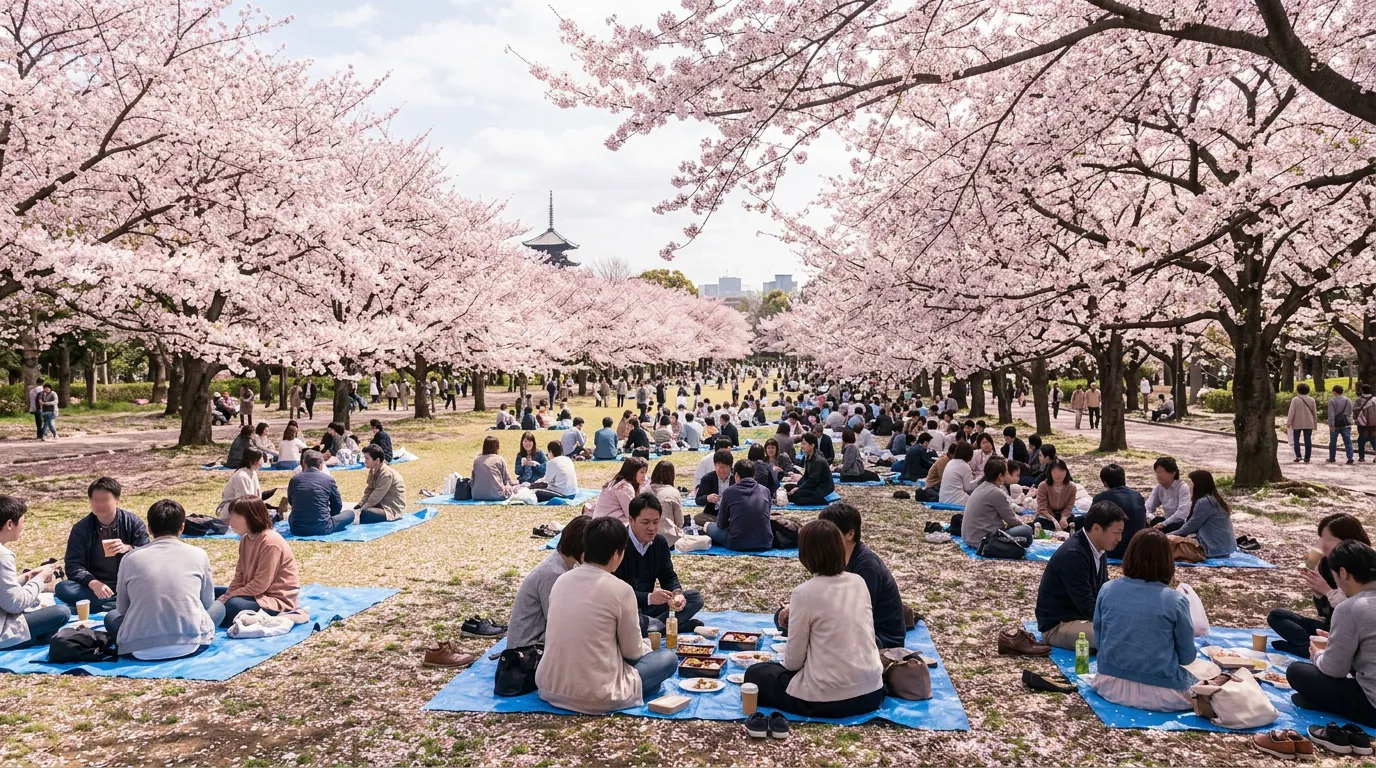
- Ueno Park. Tokyo's best-known hanami park, with long rows of trees over the central path and groups picnicking on blue sheets underneath. It is very crowded on weekends at full bloom.
- Shinjuku Gyoen National Garden. A large garden with many cherry varieties, so something is usually in flower for weeks. It charges admission (¥500 for adults), and alcohol is banned inside (Ministry of the Environment rules). Entry rules can change at the peak of the season, so check its site before you go.
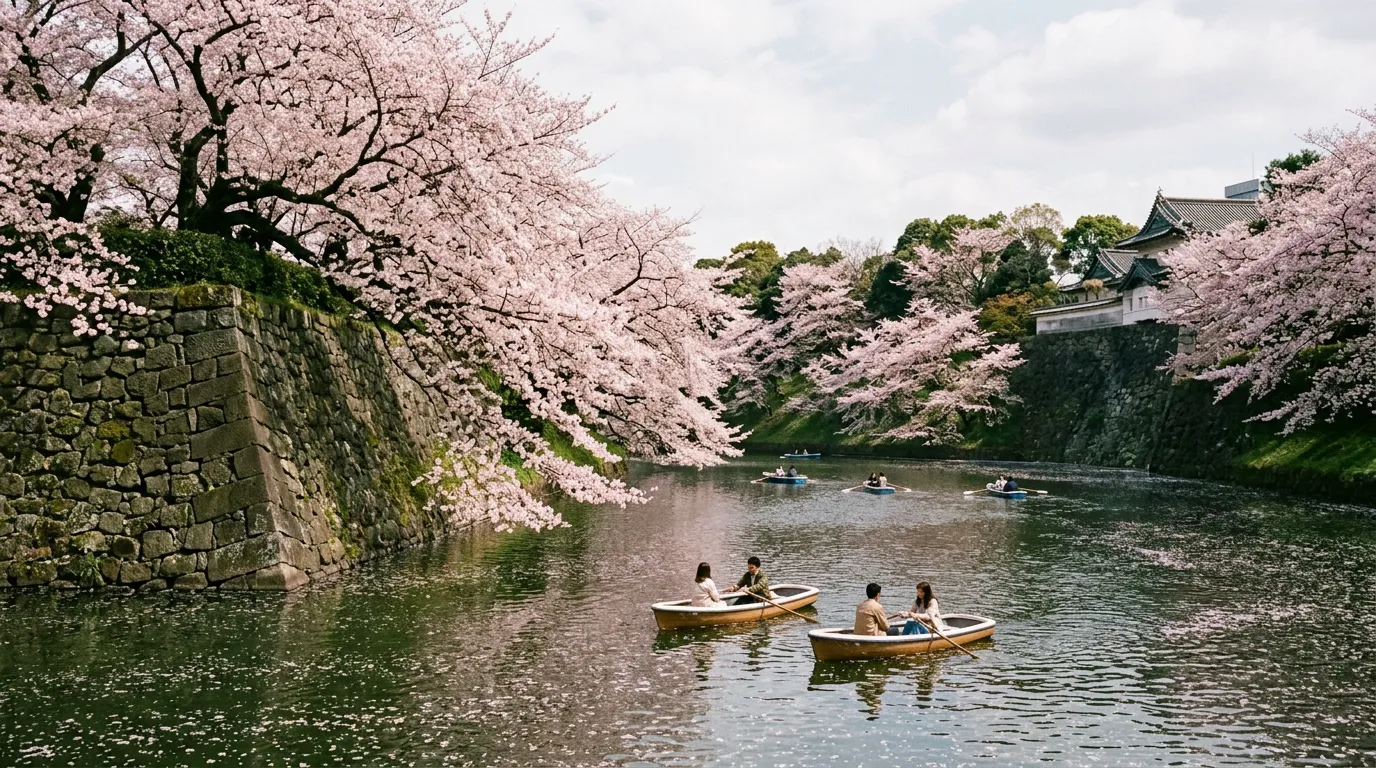
- Chidorigafuchi. The moat beside the Imperial Palace, lined with cherry trees, where you can rent a rowing boat and go under the branches.
- Meguro River. A canal-like river in the Nakameguro area with trees leaning over both banks. Best for a walk rather than a picnic.
- Sumida Park. Along the Sumida River near Asakusa, with Tokyo Skytree across the water.
Where to see cherry blossoms in Kyoto
All of these are on japan-guide.com's Kyoto cherry blossom list (japan-guide.com):
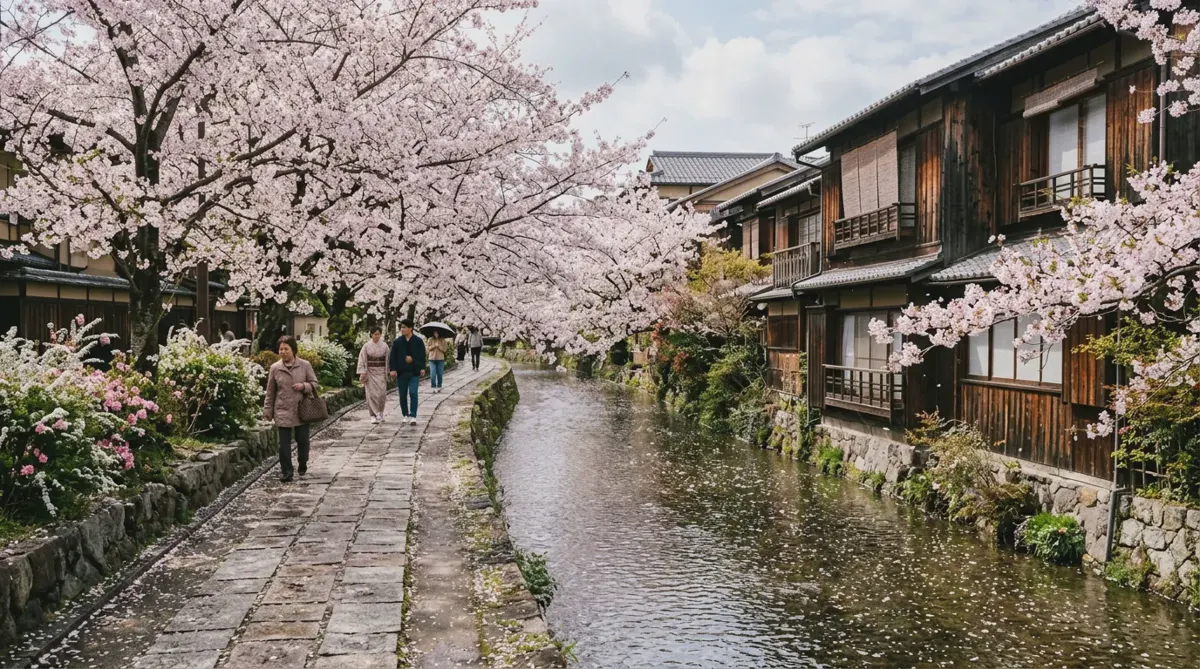
- Philosopher's Path. A canal-side path between Ginkakuji and the Nanzenji area, lined with hundreds of cherry trees. Go early in the morning: by midday it is shoulder to shoulder.
- Maruyama Park. Kyoto's most popular park for hanami parties, next to Yasaka Shrine, with food stands and a large weeping cherry lit up in the evenings.
- Heian Shrine. A garden of weeping cherries that bloom a few days after the others, good if you arrive late.
- Arashiyama. Cherry trees around Togetsukyo Bridge and Nakanoshima Park on the city's western edge. Very busy.
- Daigoji. A large temple complex in the southeast, known for its weeping cherries and for a famous hanami held there in 1598 by Toyotomi Hideyoshi.
- The Kamo River. Trees along the banks through central Kyoto, and a calmer place to sit than the famous spots.
Crowds, hotels and Golden Week
Cherry blossom season is one of the busiest times of the year to travel in Japan, for visitors and for Japanese travelers alike. Hotels in Tokyo and above all Kyoto fill up early for the last week of March and the first week of April. Book as soon as your dates are set, choose a rate you can cancel, and keep that flexibility in case the 2027 forecasts move the peak.
Golden Week is the other date to know. It is a run of public holidays at the turn of April and May. In 2027 it falls like this: Showa Day on Thursday 29 April, then Saturday 1 May to Wednesday 5 May off in a row (Constitution Memorial Day on 3 May, Greenery Day on 4 May and Children's Day on 5 May). Trains, flights and hotels across the country are at their busiest then. On the averages, Hakodate and Sapporo bloom right in or just after Golden Week, so a Hokkaido trip for the blossoms means booking early. In the south the blossoms are long gone by then.
For a calmer visit, aim for weekdays, go to the famous spots early in the morning, and use the less famous parks and riversides for your picnic.
Hanami etiquette
Hanami means "flower viewing", usually a picnic under the trees with friends, food and often drinks. A few rules keep it pleasant for everyone:
- Do not touch, climb or shake the trees. Do not pick flowers or break branches. Cherry trees are fragile, and petals falling on their own are part of the show.
- Take your rubbish home. Many parks have few bins, and some none. Bring a bag.
- Check the park's own rules. They differ from one park to the next. Shinjuku Gyoen bans alcohol and open flames; other parks allow a drink but not a barbecue. Follow the signs and the staff.
- Do not take more space than you need. In busy parks, people claim spots with sheets from early morning. Share the space, and do not leave a sheet unattended all day where it is not allowed.
- Keep the noise down, especially in the evening, and leave when the park closes or the lights go off.
- Ask before photographing people, including anyone in kimono.
Getting around: trains and rail passes
Most cherry blossom trips combine Tokyo and Kyoto, two to three hours apart by Shinkansen. The nationwide Japan Rail Pass covers JR trains, including most Shinkansen, for 7, 14 or 21 days. On 11 October 2026 the official site listed the 7-day Ordinary pass at ¥50,000 for adults when bought online, and ¥53,000 from an overseas agent (Japan Rail Pass). Whether it pays off depends on your route: for a simple Tokyo, Kyoto and back trip, add up the single fares before you buy. JR companies also sell regional passes for smaller areas.
Inside cities, an IC card such as Suica or PASMO covers subways, local trains and buses: tap in and out at the gate.
Staying connected during cherry blossom season
Your phone does a lot of the work on a blossom trip: checking each day which spots are in flower, finding your way between parks and temples, buying train tickets, and finding each other in a crowded park.
- Follow the bloom on the day. Forecasters' sites and apps report each spot's status in spring, and it changes daily. That means checking every morning, often on mobile data.
- Use a train app. Route planners such as Google Maps or Japan Transit Planner show platforms, transfers and the last train. In stations the size of Shinjuku or Kyoto, you will use them.
- Download Japanese in your translation app for offline use. The camera mode reads menus, signs and ticket machines.
- Download an offline map of the areas you will visit. In a packed park at full bloom, thousands of phones share the same cells and data slows. Agree a meeting point before you go into the crowd.
- Plan your data. Most visitors use 0.5 to 1.5 GB a day. Photos and videos of the blossoms, uploaded every evening, push that up, so pick a plan with room for them or upload on hotel Wi-Fi.
- Check what your home plan charges for Japan. Many US plans charge by the day there, and UK and Australian networks set their own rates for Japan, often as a daily fee. Our guide Will my phone work in Japan? goes through AT&T, T-Mobile and Verizon.
A daily roaming fee adds up over a two-week blossom trip. A travel eSIM installed at home is the simpler fix: a data-only line that works when you land, with your usual number still on your home SIM for calls and texts. Our Japan plans come as daily allowances, fixed data or unlimited, from a few days to a month. Check that your phone supports eSIM, install it on Wi-Fi before you fly with our iPhone or Android guide, and compare plans on our Japan eSIM page.
Landing without a plan? Our arrival guides for Narita, Haneda, Kansai and New Chitose cover the free Wi-Fi and the SIM counters at each airport. Coming back in the autumn? The leaves follow the same route in reverse: see our autumn leaves in Japan guide. Before you fly, Japan's Digital Agency runs Visit Japan Web for your arrival procedures, and from 1 November 2026 tax-free shopping is a refund claimed at departure: see how the new refund works.
FAQ
When is cherry blossom season in Japan in 2027?
The official 2027 forecasts were not published on 11 October 2026. On JMA's 1991 to 2020 averages, full bloom is around 31 March in Tokyo, 4 April in Kyoto and Osaka, 8 April in Kanazawa, 13 April in Sendai and 6 May in Sapporo. Okinawa's earlier cherries bloom from mid-January. Recent years have often run a few days to two weeks early.
When will the 2027 cherry blossom forecast be published?
For 2026, the Japan Meteorological Corporation published its first forecast in mid-December 2025 and Weathernews on 8 January 2026, with updates into March. Expect the 2027 forecasts on a similar timetable. We will add them to this guide when they come out.
What is the best week to see cherry blossoms in Tokyo and Kyoto?
On the averages, Tokyo reaches full bloom around 31 March and Kyoto around 4 April, so the last days of March and the first days of April are the safest bet for both. In 2026 both peaked a few days early, on 28 March in Tokyo and 30 March in Kyoto.
How long do cherry blossoms last?
On a single tree, about a week from full bloom, less if rain or strong wind comes through. Because the bloom moves north and some varieties flower later, the season across Japan lasts from January in Okinawa to early May in Hokkaido.
Can I drink alcohol at hanami?
It depends on the park. Shinjuku Gyoen bans alcohol. Many other parks allow it. Follow each park's signs, keep the noise down and take your rubbish home.
Will my phone work in Japan during cherry blossom season?
US, UK and Australian phones roam in Japan, but many plans charge by the day, and data slows in the busiest parks at full bloom. Check your plan's Japan rate, download an offline map and Japanese for your translation app, and consider a travel eSIM for a longer trip.
Dates checked on 11 October 2026 against the Japan Meteorological Agency's cherry blossom first-bloom and full-bloom tables (1991 to 2020 normals and the 2021 to 2026 observations), JMA's definitions of first and full bloom, Weathernews and the Japan Meteorological Corporation's first 2026 forecasts, the Ministry of the Environment's Shinjuku Gyoen rules, japan-guide.com's Kyoto cherry blossom page, the official Japan Rail Pass price page and Japan's 2027 public holidays. The photos are illustrations.