
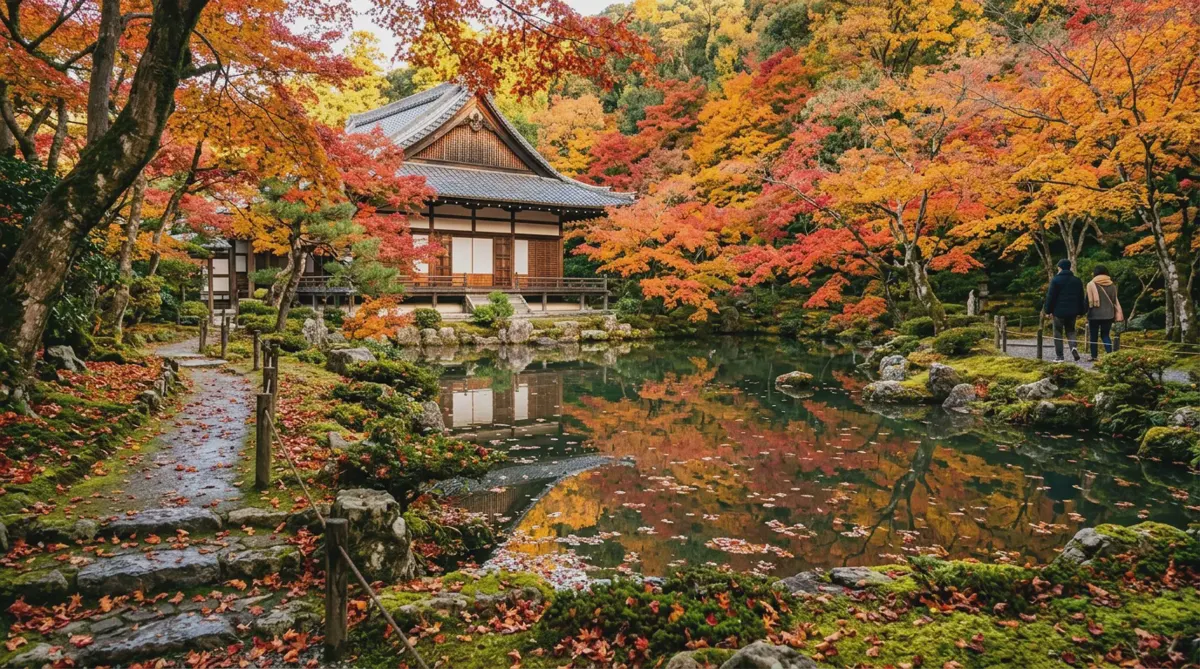
Every autumn, Japan changes color from the top down. The first maples turn on Hokkaido's highest mountains in September, and the last ones glow in Kyushu's temple gardens in December. In between, for about three months, the color moves south through the islands and down from the peaks into the cities. The Japanese call it kōyō, and going out to see it is one of the oldest seasonal pleasures in the country.
If you have only seen Japan in cherry blossom season, autumn is a different trip: warmer colors, cooler air, festivals on rivers and temples lit at night, and a season long enough that you rarely have to fight for it.
What kōyō means
The word is written 紅葉, "red leaves". The same characters can also be read momiji, which is the everyday word for the Japanese maple. Going to see the leaves is momijigari, literally "red leaf hunting". The gari (狩) is the same word used for picking fruit: you hunt with your eyes, and you go home with nothing but the view.
The custom goes back to the Heian period (794 to 1185), when the court nobles of Kyoto went out to admire the maples with boating parties, poetry and banquets. Leaf viewing appears in The Tale of Genji, and Momijigari is the title of a Noh play. For centuries it was a pastime of the upper classes; in the Edo period (1603 to 1868) it became something everyone did, and it still is.
Like cherry blossoms, autumn leaves are tied to mono no aware, a gentle awareness that beautiful things do not last. Spring's blossoms are often read as beginnings; the maples are the year's last burst of color before winter, a reason to go outside and look closely before the cold sets in.
How the color travels through the islands
The season starts in the cold north and moves south, and in each region the mountains turn first, then the parks, gardens and temples in town, according to the Japan National Tourism Organization (JNTO). The best color comes when cool mornings, sunny days and cold nights follow each other.
| Where | Usually at its best |
|---|---|
| Daisetsuzan, Hokkaido's high mountains | Mid to late September |
| Hokkaido lowlands (Sapporo, Kushiro) | Mid to late October |
| Tohoku's mountains, Oku-Nikko | October |
| Nikko town, Mount Fuji's Five Lakes | Late October to mid November |
| Tokyo, Kyoto, Osaka, Nara | Mid November to early December |
| Kyushu (Fukuoka, Kagoshima) | Late November to mid December |
These are typical windows, not promises. A warm autumn pushes everything later, and every year's dates differ. JNTO publishes a forecast by city, built on the Japan Weather Association's data, and the association's own tenki.jp autumn leaves map (in Japanese) tracks spots day by day.
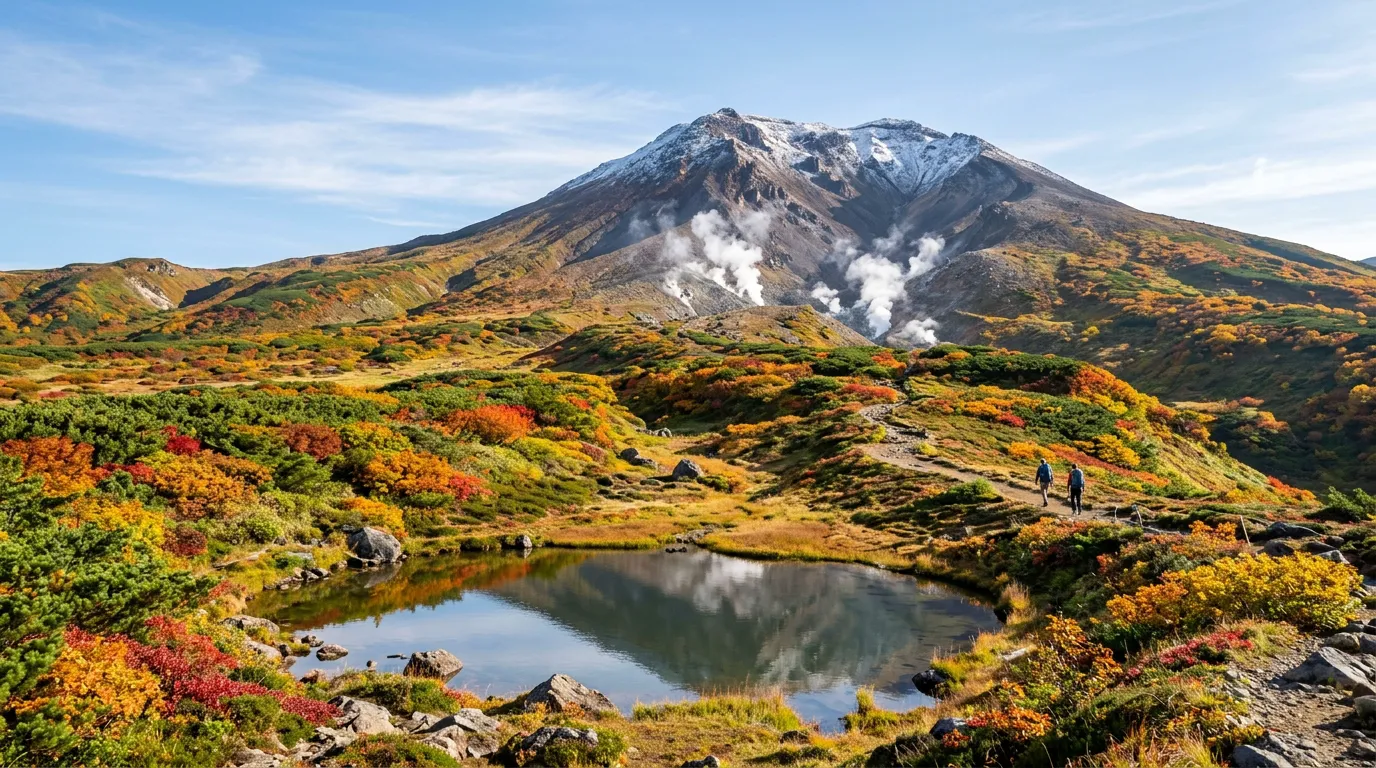
On Asahidake, in Daisetsuzan National Park, the alpine shrubs begin to turn yellow and red from around mid-September, and near the end of the month you can sometimes see autumn leaves and the first snow on the mountain at the same time, according to a Japanese government publication. It is the earliest color in Japan, and one of the strangest sights of the season.
Red maples and golden ginkgo
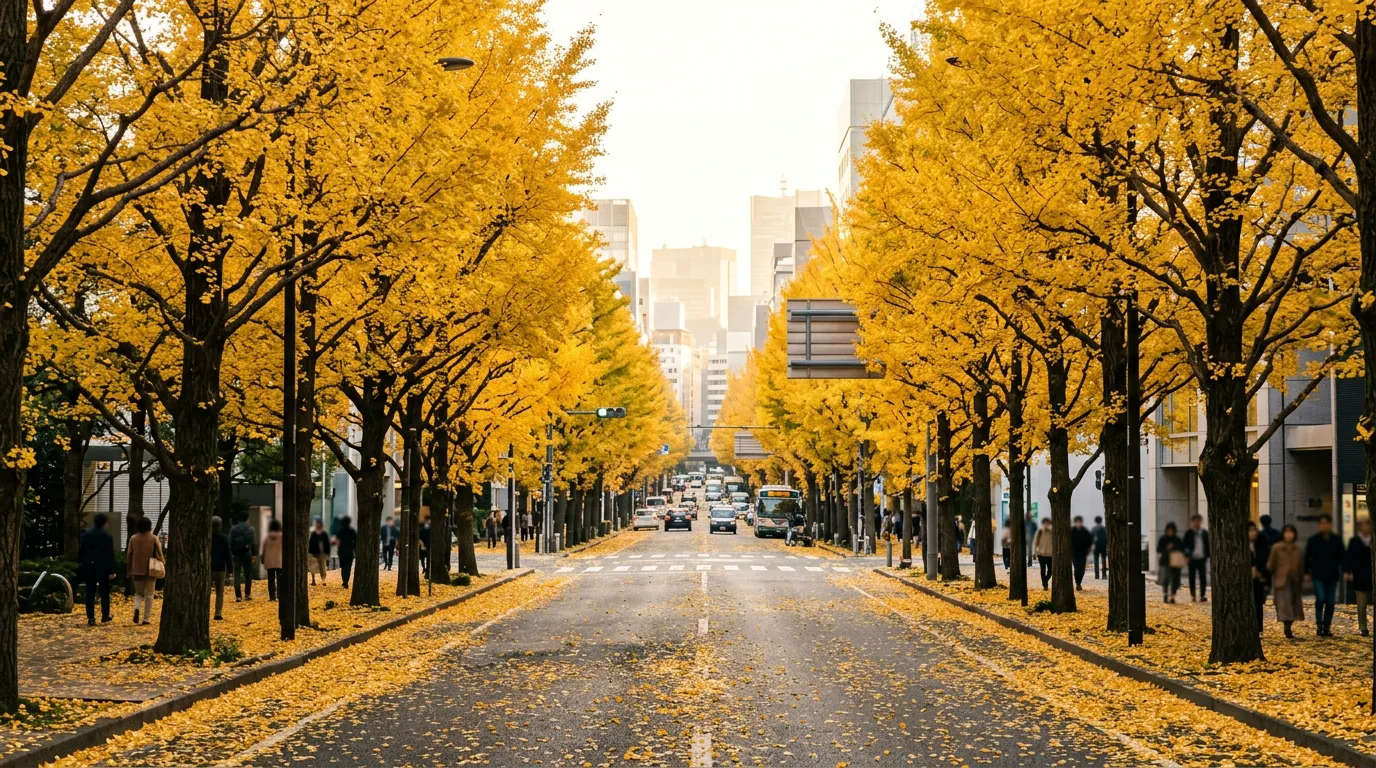
Maples give the reds, from scarlet to deep crimson. In the cities, the other star is the ginkgo, which turns a clear gold in late November. Tokyo's best known example is the ginkgo avenue at Meiji Jingu Gaien, about 146 trees along a road of roughly 300 meters in Kita-Aoyama, which drops a carpet of yellow leaves at the end of the season.
Festivals and light-ups worth planning around
Arashiyama Momiji Festival, Kyoto
The Arashiyama Momiji Matsuri is held every year on the second Sunday of November on the Oi River, upstream of Togetsukyo Bridge, according to the Arashiyama Hoshokai, which organizes it. Decorated boats leave from near the bridge and stage music and dance on the water, with performers in Heian-era court dress. The festival celebrates the maples of Arashiyama and Mount Ogura that the Heian nobles loved, and gives thanks to Zao Gongen, the guardian deity of the area.
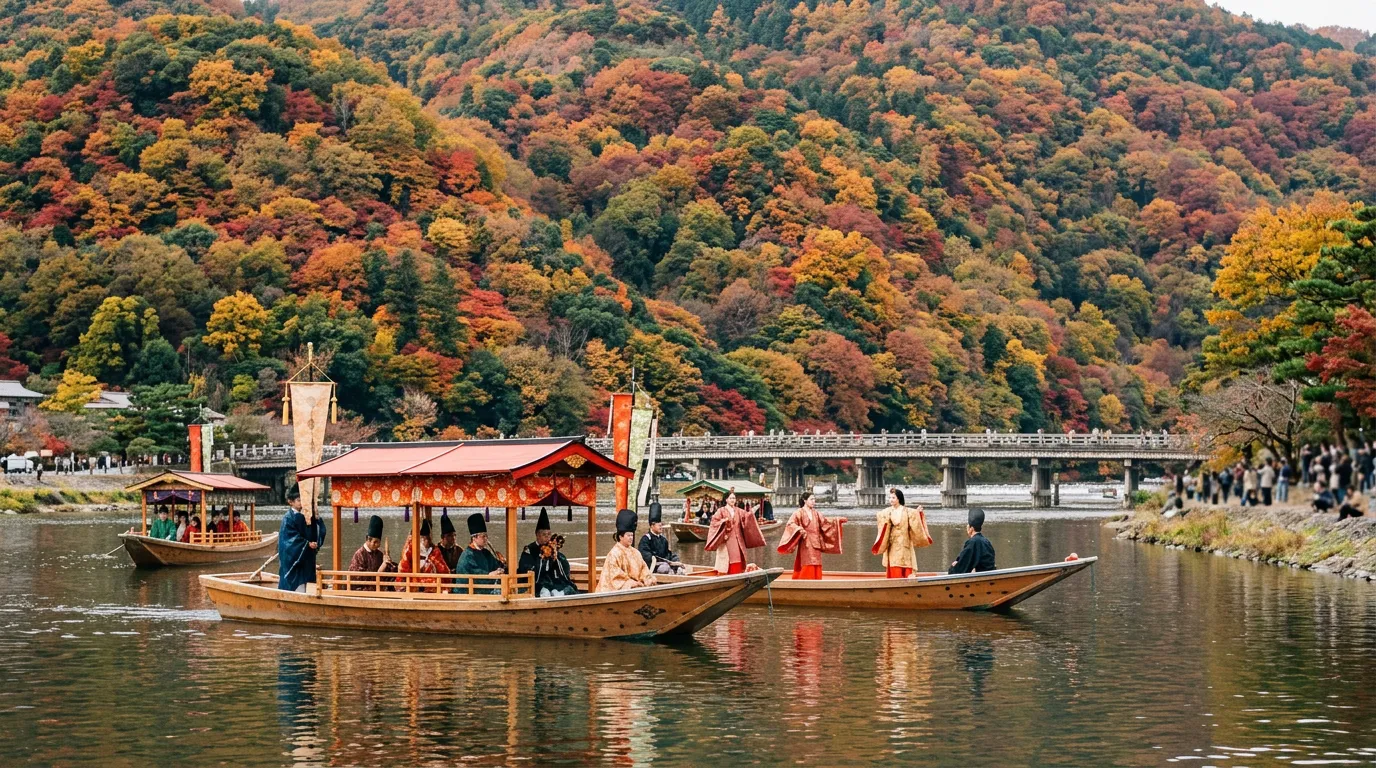
Why it is worth it: it is momijigari as the court practiced it a thousand years ago, on the same river, under the same hills. It is canceled in rain, so check the organizers' site on the morning.
Night light-ups in Kyoto
In November many Kyoto temples reopen after dark, with their maples lit from below. Two are worth the queue:
- Kiyomizu-dera holds a special night viewing in late autumn, when its maples are lit and a blue beam shines into the sky to represent the compassion of Kannon. Check the temple's site for the year's dates.
- Eikando, long nicknamed "Momiji no Eikando" (Eikando of the maples), lights its garden and pond in the evening from around mid-November. The maples reflected in the dark water are the picture most people come for. Expect a wait if you arrive before about 7 pm. See eikando.or.jp for the dates.
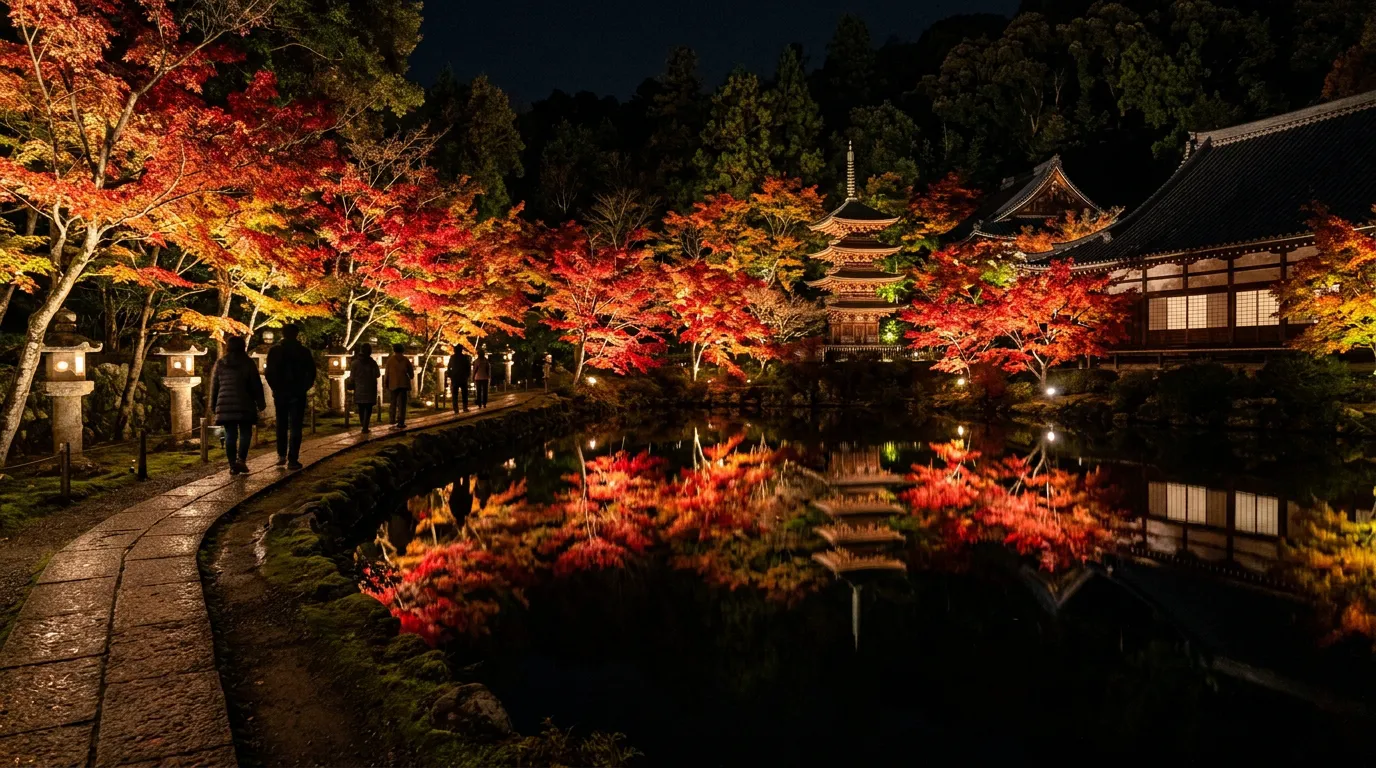
Why they are worth it: lit from below against a black sky, the leaves look like stained glass, and the temples feel completely different from the daytime crowds.
Fujikawaguchiko Autumn Leaves Festival, Mount Fuji
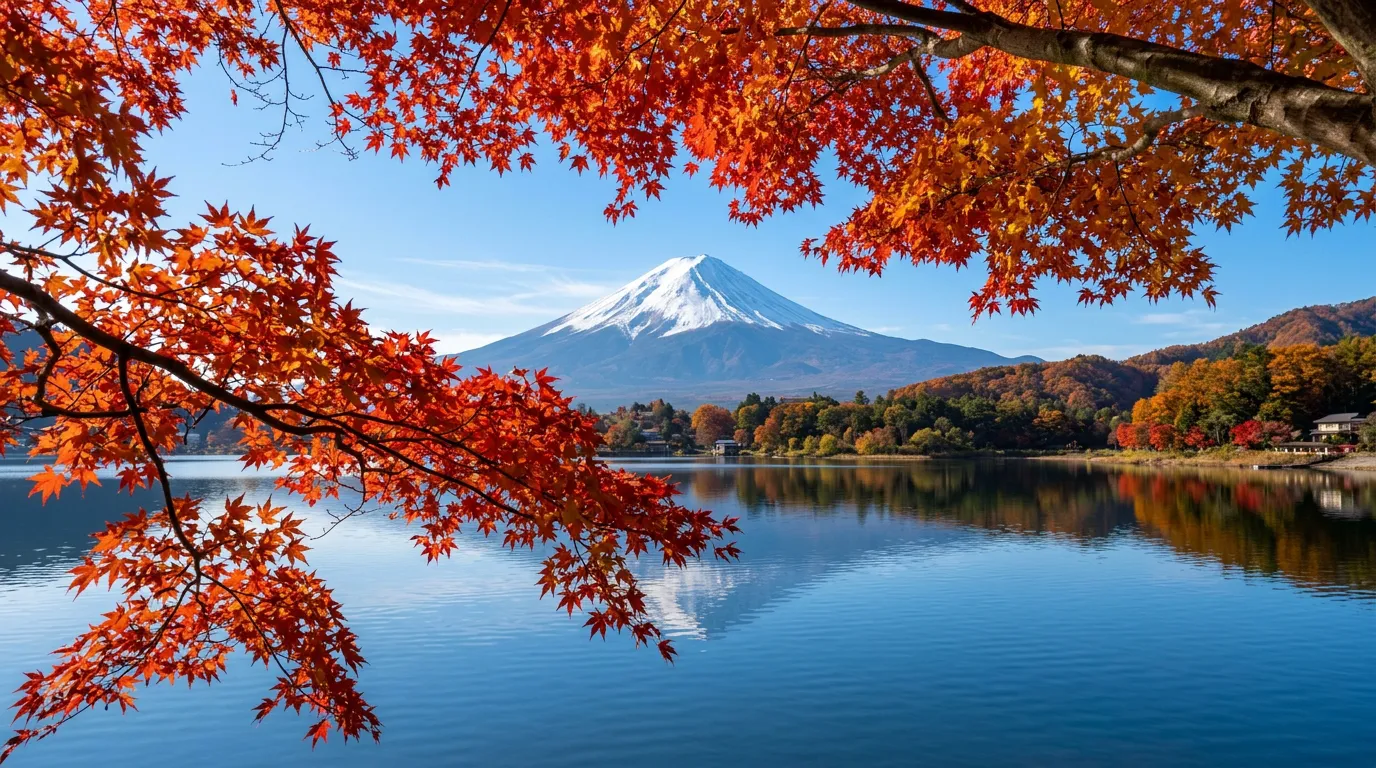
Lake Kawaguchi, at the foot of Mount Fuji, holds its autumn leaves festival through most of November. Its centerpiece is the Momiji Corridor, a path under old maples beside a stream, lit after dark. On a clear day you get red maples, a blue lake and a snow-capped Fuji in one frame, which is as close to a postcard as Japan gets.
Korankei Momiji Festival, Aichi
Korankei, a gorge in Asuke in the hills of Toyota city, Aichi, holds its maple festival through November. Around 4,000 maples cover the slopes and both banks of the Tomoe River, and the red Taigetsukyo Bridge is lit at night with the leaves reflected in the water. It is a big draw from Nagoya, so the roads jam on weekends; the Asuke tourism site has the year's details, and the bus from Toyota-shi Station saves the parking queue.
Minoo Park, Osaka: eat the leaves
Minoo Park, on the edge of Osaka, is known for its waterfall and its maples, and for something you will not find elsewhere: momiji tempura. Maple leaves are salted and kept for a year, then battered and fried one by one, and sold in shops along the path to the falls near Minoo Station. The leaf itself tastes of very little; what you get is a light, sweet, crunchy snack shaped like a maple leaf. It is the most literal way to taste the season.
Often calmer than cherry blossom season
Cherry blossoms are at their best for about a week in any one place, and much of the country goes out under the same trees on the same weekend. Autumn color lasts longer in each place, usually a couple of weeks or more, and the season runs from September to December across the country. The crowds spread out with it.
That does not make it empty. Kyoto's most famous temples are busy on peak November weekends, hotels in Kyoto and Tokyo are expensive on those weekends, and the Irohazaka switchbacks up to Oku-Nikko jam with traffic. But you have far more room to choose:
- Go north early. Hokkaido, Tohoku and the mountains around Nikko peak in October, weeks before Kyoto.
- Go up. Mountain areas turn first and stay quieter than city temples.
- Go on a weekday, and go early. Morning light is better for photos anyway.
- Pick the shoulder week. The week before peak often has most of the color and fewer people.
- Stay the night. Places like Nikko, Arashiyama or Lake Kawaguchi are calm once the day trippers leave.
Staying connected on a kōyō trip
Chasing autumn color is a trip you plan as you go. The forecasts update as the weather changes, so you check the leaf maps, move a day trip to where the color is, look up train times and see whether tonight's light-up has a long queue. All of that needs data in the street, at a station or on a mountain road, not only on the hotel Wi-Fi. Busy viewpoints can slow mobile data for everyone, so save tickets and maps offline before you set out.
A Japan eSIM installed before you fly works from the moment you land at Narita, Haneda or Kansai, with nothing to collect at the airport. If you are weighing it against a rented router, see eSIM vs pocket Wi-Fi in Japan, and check first that your phone supports eSIM.
Shopping on the way? From 1 November 2026, tax-free shopping in Japan works as a refund: see how the new refund works.
FAQ
When is the best time to see autumn leaves in Japan?
It depends on where you go. Hokkaido's high mountains turn in mid to late September, Hokkaido's cities and Tohoku in October, and Tokyo, Kyoto and Osaka from mid November to early December. Kyushu is last, into mid December.
What does momijigari mean?
Momijigari means "red leaf hunting": going out to see the autumn leaves. The custom dates back to the Heian period, when Kyoto's nobles admired the maples with boating, poetry and banquets.
Is autumn leaf season less crowded than cherry blossom season?
Usually, because the color lasts longer in each place and the season runs for about three months across the country. Kyoto's famous temples are still busy on peak weekends, so go on a weekday, early in the day, or somewhere further north in October.
When is the Arashiyama Momiji Festival?
It is held on the second Sunday of November on the Oi River in Arashiyama, Kyoto, with decorated boats and performances in Heian-era dress. It is canceled in rain.
Can you eat maple leaves in Japan?
Yes, in Minoo, on the edge of Osaka, where maple leaves are salted, battered and fried as momiji tempura. The result is a sweet, crunchy snack sold along the path to Minoo waterfall.
Facts checked on 8 October 2026 against JNTO, the Japan Weather Association (tenki.jp), the Government of Japan, the Arashiyama Hoshokai and the official sites of Kiyomizu-dera, Eikando and Asuke. Peak dates move with each year's weather, so check a current forecast before you book. The photos are illustrations.