
Last updated: 17 October 2026
Yes, your US phone will work in Costa Rica. Verizon, AT&T and T-Mobile all roam on Costa Rican networks. On most plans, though, it costs $10 to $12 a day per line, so a 10-day trip for two can add more than $200 to your bill.
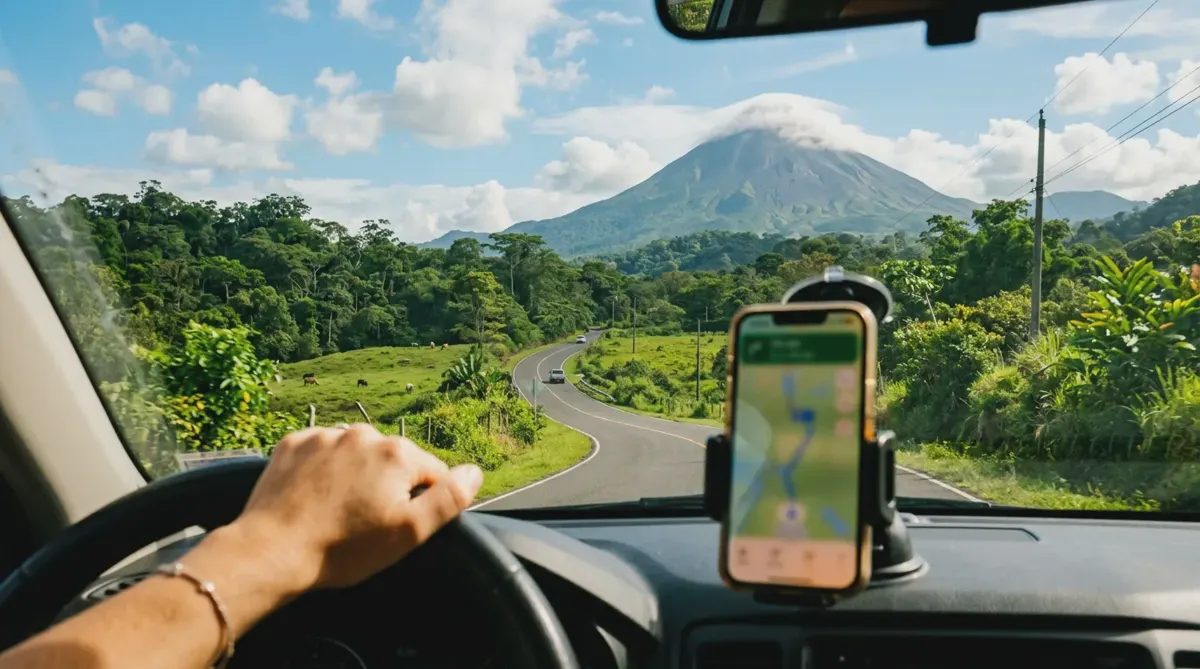
Costa Rica is also a country where you really need mobile data: addresses have no street numbers, most visitors rent a car, and everyone drives with Waze. Here is what your carrier charges, where coverage drops, what to know before you land, and when a travel eSIM is the better buy.
What your US carrier charges in Costa Rica
| Carrier | In Costa Rica |
|---|---|
| Verizon | TravelPass at $12 a day per line. Unlimited Ultimate includes 15 GB of high-speed data a month |
| AT&T | Included on Unlimited Premium 2.0 and Elite 2.0, which cover 20 Latin American countries. Other plans: International Day Pass, $12 a day, at most 10 days charged per bill period |
| T-Mobile | Your plan's included data abroad (5 GB on Experience More, 15 GB on Experience Beyond), or a pass from $10 a day. Essentials has no data without a pass |
The details, and what starts a day pass without you noticing, are in our guides to Verizon, AT&T and T-Mobile.
A travel eSIM is a second, data-only line for the trip. Your US line stays on for calls and texts, including bank codes, and the eSIM carries your data at a fixed price. Ours costs $17.99 for 7 days with 1.5 GB a day, $29.99 for 15 days, or $20.99 for 5 GB over 30 days if you mostly use hotel Wi-Fi. See the plans on our Costa Rica eSIM page.
Your carrier is the better choice if you are on AT&T Premium 2.0 or Elite 2.0, on Verizon Unlimited Ultimate within its 15 GB, on T-Mobile with enough included data, or for a trip of a day or two.
Why you need data to drive in Costa Rica
Costa Rican addresses are given as directions, not numbers: a hotel is "200 meters north of the church", a restaurant "next to the old soccer field". Road signs are few outside the main highways, and the roads to beaches, volcanoes and cloud forests are often narrow, steep or unpaved.
So most drivers, locals included, navigate with Waze, and a rental car without mobile data makes for a long day. A few tips:
- Download offline maps of your route in Google Maps as a backup. Waze needs a connection to route you.
- Check the route, not only the distance. A 100 km drive can take three hours, and a shortcut on the map can be a river crossing or a dirt track. Rent a 4x4 for Monteverde, the Osa Peninsula or the Nicoya back roads.
- Do not drive at night if you can avoid it: roads are dark, narrow and shared with pedestrians and animals.
- Keep your phone charged with a car charger, and a power bank for the day.
Coverage: where your phone works
Costa Rica has three mobile networks: Kölbi, the state operator, which reaches furthest into the countryside, Claro and Liberty. Between them, coverage is good in:
- San José and the Central Valley, around the main airport (SJO).
- Guanacaste: Liberia airport (LIR), Tamarindo, the Papagayo Peninsula and the beaches of the Pacific north.
- La Fortuna and the Arenal volcano, and Manuel Antonio on the central Pacific.
It gets thin or disappears:
- In the national parks, especially Corcovado on the Osa Peninsula, and on the trails of Monteverde.
- At Tortuguero, which you reach by boat, and in the mountains between regions.
- On parts of the Caribbean coast south of Puerto Viejo.
Download what you need before you go: offline maps, your bookings, your park tickets, and the directions to your next hotel.
Before you land
- Entry: US citizens do not need a visa for tourism. The immigration officer decides how long you can stay, up to 180 days, and you need proof of a return or onward ticket: airlines check it at check-in. Your passport should be valid for your whole stay; check the current rules with Costa Rica's immigration office or the State Department before you book.
- Departure tax: usually included in your airfare. If not, you pay it at the airport before you leave.
- Safety: the US State Department rates Costa Rica at Level 2, "Exercise increased caution", in its advisory of 2 April 2026, because of crime. Petty theft is common, especially from rental cars at beaches and trailheads: never leave anything in the car.
- Spring break and Easter: the dry season runs roughly from December to April, and it is the busiest time to visit. Holy Thursday and Good Friday (25 and 26 March in 2027) are public holidays, when Costa Ricans head to the beach too: book early. More in our guide to Semana Santa 2027.
How to set it up
- Check your phone is unlocked: how to check and unlock it.
- Install the eSIM at home, on Wi-Fi, on the day you leave, before you go to the airport: iPhone or Android. On most plans the days start when the eSIM first connects in Costa Rica, and each plan states its rule.
- When you land at SJO or LIR, set the eSIM as your line for data and turn on data roaming for the eSIM line. You are online before you reach the rental car desk.
- Turn data roaming off on your US line, so it never starts a day pass. Leave the line on for texts if you want them, but remember a call or a sent text starts a day on Verizon and AT&T.
If your US iPhone is eSIM-only, you cannot use a Costa Rican SIM card anyway: does the iPhone 17 have a SIM card?
FAQ
Will my US phone work in Costa Rica?
Yes. Verizon, AT&T and T-Mobile all roam there. It is included on AT&T Unlimited Premium 2.0 and Elite 2.0, and part of T-Mobile's included data abroad; on most other plans it costs $10 to $12 a day per line.
Do I need an eSIM for Costa Rica?
Not if your plan includes enough data there. Otherwise a travel eSIM is usually cheaper: $17.99 for 7 days with 1.5 GB a day, against $84 for a week of Verizon TravelPass.
Does Waze work in Costa Rica?
Yes, and most drivers use it, because addresses have no street numbers and signs are few. It needs mobile data, so download offline maps in Google Maps as a backup for areas without coverage.
Which mobile network is best in Costa Rica?
Kölbi, the state operator, reaches furthest into the countryside and the national parks. Claro and Liberty cover the cities and the main beach towns. In Corcovado and Tortuguero, expect no signal on any network.
Do US citizens need a visa for Costa Rica?
No, not for tourism. The immigration officer sets your stay, up to 180 days, and you need proof of a return or onward ticket. Check the current rules before you book.
Is Costa Rica safe for tourists?
The US State Department rates it at Level 2, "Exercise increased caution", because of crime. The most common problem is theft, especially from parked rental cars, so never leave bags in the car.
Facts checked on 17 October 2026 against our Verizon, AT&T and T-Mobile guides, the US State Department's Costa Rica advisory of 2 April 2026, Costa Rica entry and network guides, and our catalogue.