Stay online in Costa Rica from the moment you land in San José or Liberia. Install a data eSIM before you fly, skip the SIM counter in arrivals, and keep your usual number for calls and texts while you use Waze, WhatsApp and your bookings on the road.
Costa Rica eSIM

Costa Rica eSIM plans
Every plan is data only, priced in US dollars, with no contract and nothing to return.
Our picks
Three plans we would buy ourselves, by the trip you are taking. Every plan we sell is listed below.
Short trip
10.5 GB
1.5 GB a day
7 days
A week or so away: maps, messages, rides and the odd video call.
Part of the Global (170 countries) bundle
$17.99
Buy this planLong trip
22.5 GB
1.5 GB a day
15 days
Two weeks or more, with room for photos, streaming and work email.
Part of the Global (170 countries) bundle
$29.99
Buy this plan
Also covered by Global (170 countries)
One eSIM that also works in the other countries of the bundle, for a trip that crosses borders.
See every country in Global (170 countries)
No eSIM, no charge. If your payment goes through and we cannot issue your eSIM, we refund you in full. Refund policy
Real people. A person answers every day, 07:00 to 23:00 Paris time, within 2 hours. How we look after you
Safe checkout. Secure payment by Stripe. Cards, Apple Pay and Google Pay.
Local networks. See which ones it uses in Costa Rica
Which plan fits your trip
Costa Rica is sold on our global plans, which cover it together with more than 160 other countries in one install. They suit a stay in Costa Rica alone as well as a trip that goes on to Panama, Nicaragua or the United States. The plan cards above show the days and data on sale:
- Daily data suits steady use: navigation, messages and photos every day. A road trip between the volcanoes, the cloud forest and the coast is steady from day to day, so this is the usual pick.
- Fixed data suits a longer, lighter stay, where you use your lodge's Wi-Fi and mobile data only when you are out.
See fixed, daily or unlimited for how each type behaves.
Landing in San José or Liberia
Most visitors arrive at Juan Santamaría airport near San José, or at Daniel Oduber airport in Liberia, the gateway to Guanacaste's beaches. Install the eSIM at home while you are on your own Wi-Fi, then turn on data roaming for the eSIM line once you are off the plane. You can then message your rental car company or shuttle before you reach the exit.
Driving with mobile data
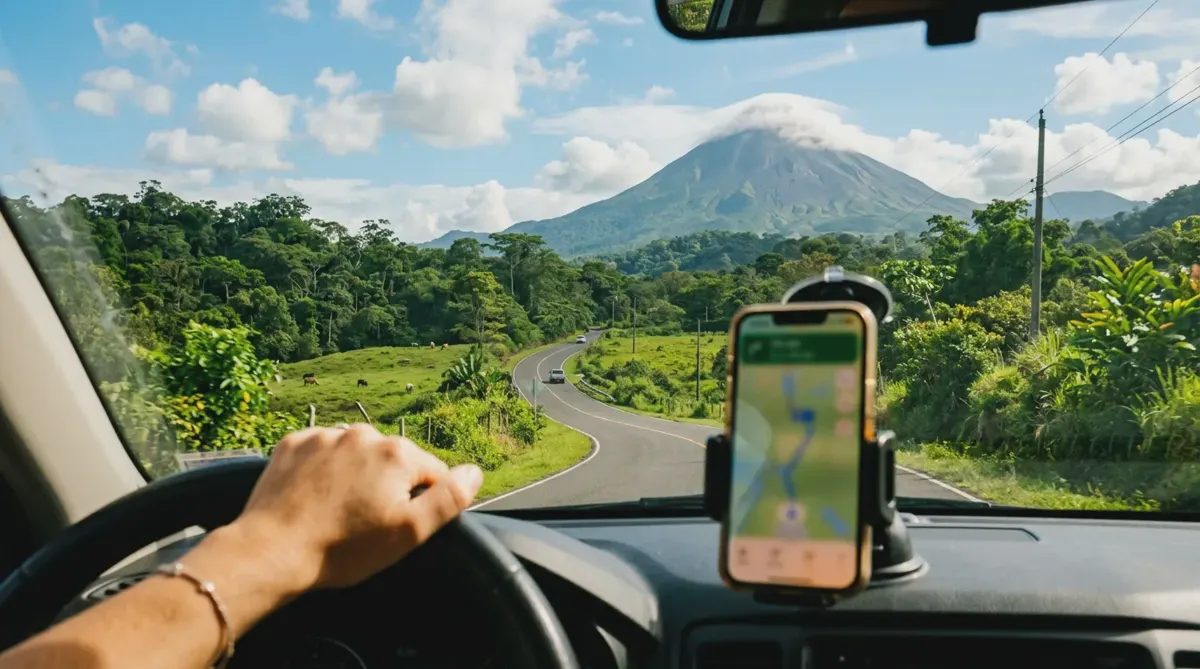
Many visitors rent a car, and Waze and Google Maps are how most drivers find their way: street addresses are rare, and directions are often given from landmarks. Keep data on for the drive, and download offline maps of the areas you will cross before you set off, since mountain roads and river valleys have gaps.
Coverage in towns and in the wild
Coverage is good in San José, around La Fortuna and Arenal, in Monteverde town, along the Guanacaste beaches such as Tamarindo, and in Manuel Antonio and Puerto Viejo. It thins out or disappears in the deep rainforest: Corcovado and the Osa Peninsula, the canals of Tortuguero, remote stretches of the Nicoya Peninsula and on high cloud-forest trails. Lodges in those places usually have Wi-Fi; save your bookings and tickets to the phone before you go.
How much data do you need?
A typical traveler using maps, messaging and photos uses about 1 GB a day. Video calls, uploading videos and working from a laptop push that up, so a remote worker in Santa Teresa or Nosara should pick the largest daily allowance on sale.
Networks in Costa Rica
Costa Rica's mobile networks are Kölbi, run by the state operator ICE and known for the widest coverage in the countryside, Claro and Liberty. A travel eSIM connects to a local network as a roaming partner, which is why data roaming must be on for the eSIM line. The partner network can differ from plan to plan, so check the plan details, or ask us at support@esimlounge.com before you buy.
How to install your eSIM
Install it at home before you fly, then switch it on when you land.
Check your phone
Your phone must support eSIM and be carrier unlocked. Most phones from the last few years do.
Scan the QR code
Scan the code from your email while you still have Wi-Fi at home. It takes about two minutes.
Switch on when you land
Turn on the eSIM line and data roaming for it. Keep your usual SIM for calls and texts if you like.
Costa Rica eSIM questions
Is an eSIM cheaper than my own carrier's roaming in Costa Rica?
Usually, yes. UK, US and Australian carriers typically charge a daily pass for each day you use your phone abroad, and over a week those passes add up to more than a plan here. Check your own plan's roaming terms to compare.
Should I buy a SIM card at the airport in Costa Rica instead?
For data, an eSIM is simpler: you set it up at home, skip the queue in arrivals and keep your usual SIM in the phone. A local SIM gives you a Costa Rican phone number, which a travel eSIM does not. If you need a local number, buy one in town with your passport; for maps and messaging, the eSIM does the job.
Will Waze and Google Maps work for a road trip?
Yes. The eSIM gives you mobile data, so Waze and Google Maps work as they do at home. Download offline maps before long drives, since some mountain roads and valleys have no signal.
Does it work in Monteverde, La Fortuna and on the beaches?
Yes, in the towns and along the main beach areas. It can drop on forest trails, in Corcovado and Tortuguero and on remote stretches of coast, where your lodge's Wi-Fi is the backup.
Can I use the same eSIM if I also visit Panama or Nicaragua?
Yes, if the countries are on the plan's list. Costa Rica is sold on our global plans, so one install keeps you online across the countries the plan covers. Check the list on the plan before you buy.
Will I keep my phone number?
Yes. Your usual SIM stays in the phone for calls and texts, and the eSIM carries your mobile data. Keep data roaming off on your usual SIM to avoid roaming fees from home.
When does the plan start counting days?
On most plans the days start when the eSIM first connects to a network at your destination, not when you install it. The plan details say how yours works.
Costa Rica travel guides
Our guides for getting online there.