
Last updated: 16 October 2026
The northern lights season in Iceland runs from late August to mid-April. Outside those months the nights are too bright. The best chances usually come in late September to October and February to March, when the nights are long but the weather is milder than in midwinter, and the sun is still close to the peak of its 11-year cycle, so the 2026-27 season should stay strong.
What decides whether you see them is not the month but the night: you need darkness, clear skies and some solar activity, all at once. Here is when to go, where to look, how to read the Icelandic forecast, how to photograph the aurora with your phone, and how to stay safe and online on dark winter roads.
When to see the northern lights in Iceland
| Months | Darkness | Weather | Verdict |
|---|---|---|---|
| Late August to mid-September | Short nights, getting longer | Mild, roads open everywhere | Possible late at night, a good bet if you also want to hike |
| Late September to October | Long nights | Cool, mostly before the winter storms | One of the best windows |
| November to January | Longest nights: about four hours of daylight around Christmas | Cold, stormy, roads can close | Most hours of darkness, but more cloud and fewer day trips |
| February to March | Long nights, days lengthening | Cold, often clearer | One of the best windows |
| Early to mid-April | Nights getting short | Spring, unsettled | The last chances of the season |
The sun is still active. The aurora depends on solar activity, which follows a cycle of about 11 years. The current cycle peaked around late 2024 and 2025, and space-weather forecasters expect activity to stay high through 2026 and into 2027. That makes this winter one of the better ones of the decade, though no single night is ever guaranteed.
Plan for at least four or five nights. Iceland's weather changes fast and cloud is the usual spoiler, so the more nights you have, the better your chances. Keep your evenings free, and decide on the day.
How to read the aurora forecast
The Icelandic Met Office publishes an aurora forecast at en.vedur.is, in the weather forecasts section. It shows two things:
- A cloud cover map for the evening and night: green is cloud, white is clear sky. A slider moves through the hours. This is the part that matters most in Iceland: a strong aurora above a thick cloud is invisible.
- An activity forecast on a scale of 0 to 9. Iceland lies right under the auroral oval, so even a low number can give a display. The Met Office itself says a 2 can be beautiful and a 3 dazzling. Higher numbers are rare.
How to use it:
- Look at the cloud map first. Find where the white is tonight, then go there. On a cloudy night in Reykjavík, the north around Akureyri or the east can be clear, and the other way around.
- Then check the activity. Anything from 2 up is worth going out for if the sky is clear.
- Go out between about 9 pm and 2 am, give your eyes 15 minutes in the dark, and be patient: the aurora comes and goes, often in waves.
To the naked eye, a weak aurora can look like a pale gray or whitish arc. Your phone's camera often shows the green before your eyes do.
Where to see the northern lights
The rule is simple: get away from city lights, and toward the clear sky on the cloud map.
Near Reykjavík, for a first night or a night without a car:
- Grótta lighthouse, at the tip of Seltjarnarnes, about 15 minutes from the center. Dark enough on a strong night, and easy to reach.
- Þingvellir National Park, about 45 minutes away, with dark skies over the rift valley.
- The Reykjanes peninsula, near the airport, for wide, empty views, though check SafeTravel for any volcanic activity before you go there.
Around the island:
- The south coast: the waterfalls at Seljalandsfoss and Skógafoss, the black beaches near Vík, and the Jökulsárlón glacier lagoon, where the aurora reflects in the water.
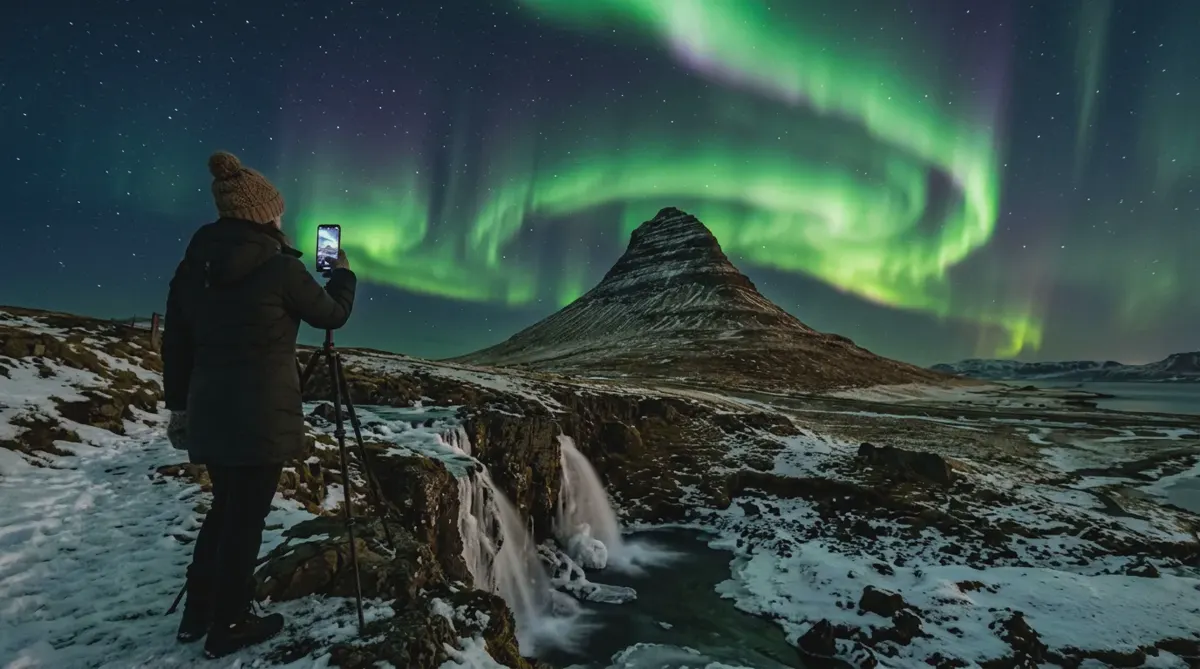
- Snæfellsnes: Kirkjufell, the mountain on half the aurora photos of Iceland, about two and a half hours from Reykjavík.
- The north: Akureyri and Lake Mývatn, often clearer than the southwest, and quieter.
On a tour or on your own? A tour from Reykjavík costs more but has a guide who reads the forecast and drives the dark roads for you, and many tours offer another night free if you see nothing. On your own, you save money and keep your freedom, but you drive at night on roads that can be icy and unlit.
Driving at night in winter
If you drive yourself, Iceland's official safety services are the place to start:
- Check road.is for road conditions and closures before every drive, or call 1777. A road marked "Lokað" is closed.
- Check safetravel.is for weather alerts and warnings, and leave your travel plans there if you head somewhere remote.
- Stop only in safe places. SafeTravel warns that many accidents happen when tourists stop on the road to take photos. Never park on the road or the shoulder for the aurora: find a parking area or a side road.
- Drive slower than the limit in winter, keep your headlights on at all times (they are required), and never drive off-road: it is illegal.
- Rent a car with winter tires, which rental companies fit from autumn, and fill up when you can: gas stations are far apart outside the towns.
In an emergency, call 112.
Photographing the aurora on your phone
Recent phones take good aurora photos, often better than you expect:
- Use Night mode on an iPhone, Night Sight or Astrophotography mode on a Pixel, or Night or Pro mode on a Samsung. The phone takes a long exposure, from a few seconds up to 30.
- Keep the phone perfectly still. Rest it on a rock or the car roof, or bring a small tripod, which also unlocks the longest exposures.
- Turn off the flash, and focus on infinity in Pro mode if your phone has it.
- Include something in the foreground: a mountain, the lighthouse, a reflection in the water.
The cold drains batteries fast. A phone can lose a big share of its charge in minutes on a freezing night, or shut down even with charge left. Keep it in an inside pocket between shots, and carry a power bank.
Staying connected in Iceland
Mobile coverage is good in the towns and along the Ring Road, and thinner in the fjords, on mountain passes and in the highlands, which are closed in winter anyway. A few things help:
- Download offline maps of the areas you will drive through.
- Keep the forecast open: the cloud map and road.is are what you will check most, often from a parking area in the dark.
- Share your location with someone back at the hotel when you drive out at night.
What your US plan costs in Iceland: Iceland is international roaming on every US carrier: TravelPass on Verizon and the Day Pass on AT&T at $12 a day per line, or T-Mobile's included allowance. Our guides for Verizon, AT&T and T-Mobile explain the details.
Our Iceland eSIM costs $13.99 for 7 days with 1.5 GB a day, or $22.99 for 15 days, and works as soon as you land at Keflavík, with your US number still on for calls and texts. Check that your phone is unlocked first (how to check), then install it on Wi-Fi before you fly: iPhone or Android.
Iceland is in the Schengen area, so the EU's Entry/Exit System now scans your passport and takes your photo when you arrive: see our guide to entering Europe in 2026.
FAQ
When is the best time to see the northern lights in Iceland?
The season runs from late August to mid-April. Late September to October and February to March are usually the best windows: long nights, milder weather than midwinter, and often clearer skies. Plan for four or five nights to give the weather a chance.
Will the northern lights be good in 2026 and 2027?
Yes, most likely. The sun's 11-year cycle peaked around late 2024 and 2025, and forecasters expect activity to stay high through 2026 and into 2027. Clear skies still matter more than the cycle on any given night.
Can you see the northern lights from Reykjavík?
Yes, on a strong night, especially from darker spots such as the Grótta lighthouse. For better chances, drive 30 to 60 minutes out of the city, to Þingvellir or the Reykjanes peninsula.
How do I read the Iceland aurora forecast?
On the Icelandic Met Office's aurora page, look at the cloud map first: white is clear sky, green is cloud. Then check the activity number from 0 to 9: in Iceland, even a 2 can give a good display if the sky is clear.
Can I photograph the northern lights with my phone?
Yes. Use Night mode, Night Sight or a Pro mode, keep the phone completely still on a rock or a small tripod, and turn off the flash. The camera often picks up the green before your eyes do.
Does my US phone work in Iceland?
Yes, on roaming: about $12 a day per line on Verizon and AT&T, or T-Mobile's included allowance. An Iceland travel eSIM costs $13.99 for 7 days.
Facts checked on 16 October 2026 against the Icelandic Met Office aurora forecast, SafeTravel (ICE-SAR) and road.is, Iceland travel guides on the 2026-27 season, and our catalogue and carrier guides.