
Last updated: 8 October 2026. Checked against the European Commission, the EU's official Travel to Europe portal and GOV.UK.
If you are not an EU citizen and you visit the Schengen area for a short stay, the Entry/Exit System (EES) applies to you now: it has been fully operational at every Schengen external border since 10 April 2026. ETIAS, the EU's separate online travel authorisation, is not running yet and takes no applications, so there is nothing to apply for. The UK is different again: since 25 February 2026 most visitors who do not need a UK visa, EU citizens included, must hold a £20 Electronic Travel Authorisation (ETA) before they travel.
The three systems side by side
| EES (Schengen area) | ETIAS (Schengen area plus Cyprus) | UK ETA | |
|---|---|---|---|
| Status on 8 October 2026 | Live. Fully operational since 10 April 2026 | Not in operation. No start date announced | Live. Mandatory since 25 February 2026 |
| What it is | Biometric registration at the border, replacing passport stamps | Online travel authorisation before you travel | Online travel authorisation before you travel |
| Who it covers | Non-EU nationals on a short stay, with or without a visa | Visa-exempt non-EU nationals (once it starts) | Visitors who do not need a UK visa, including EU citizens; not British or Irish citizens |
| What you do | Give fingerprints and a face photo at passport control on your first crossing | Nothing yet | Apply on the UK ETA app or GOV.UK before you travel |
| Cost | No application to buy: it happens at the border | EUR 20 once it starts | £20 |
| Validity | Record kept for 3 years | 3 years or until the passport expires (once it starts) | 2 years or until the passport expires |
EES: what changed at Schengen borders
The European Commission confirmed that the Entry/Exit System became fully operational on 10 April 2026 across all Schengen external border crossing points, after a progressive rollout that began on 12 October 2025.
- Where: EES is used by 29 European countries. Cyprus and Ireland do not use it, according to the Commission's EES policy page.
- Who: it applies to non-EU nationals traveling for a short stay (up to 90 days in any 180 days), whether they need a short-stay visa or are visa-exempt, according to the official EES FAQ. That includes travelers from the UK, the US, Canada and Australia.
- What is recorded: your name, travel document data, fingerprints, a facial image and the date and place of each entry and exit. Records are kept for three years (European Commission).
- Fingerprints: visa-exempt travelers give four fingerprints and a facial image. Visa holders give only a facial image, because their fingerprints were taken for the visa. Children under 12 are not fingerprinted (EES FAQ).
- No more stamps: manual passport stamping was abolished on 10 April 2026, when the automated 90/180 day calculator started working (EES FAQ).
Who is exempt from EES
The Commission listed the exemptions on 27 July 2026. You are not registered in EES if you are:
- a citizen of an EU country, Iceland, Liechtenstein, Norway or Switzerland;
- a national of Andorra, Monaco or San Marino, or a holder of a passport issued by the Vatican City State or the Holy See;
- a non-EU national holding a residence permit or a long-stay visa issued by a country that operates EES (permits and long-stay visas issued by Cyprus or Ireland do not exempt you);
- a non-EU family member of an EU citizen who holds a residence card or permit.
UK nationals covered by the Brexit Withdrawal Agreement are exempt only if they hold a Withdrawal Agreement residence document or one of the other documents listed in the EES FAQ. Without one, they are registered and can later ask for their data to be deleted.
What happens at passport control
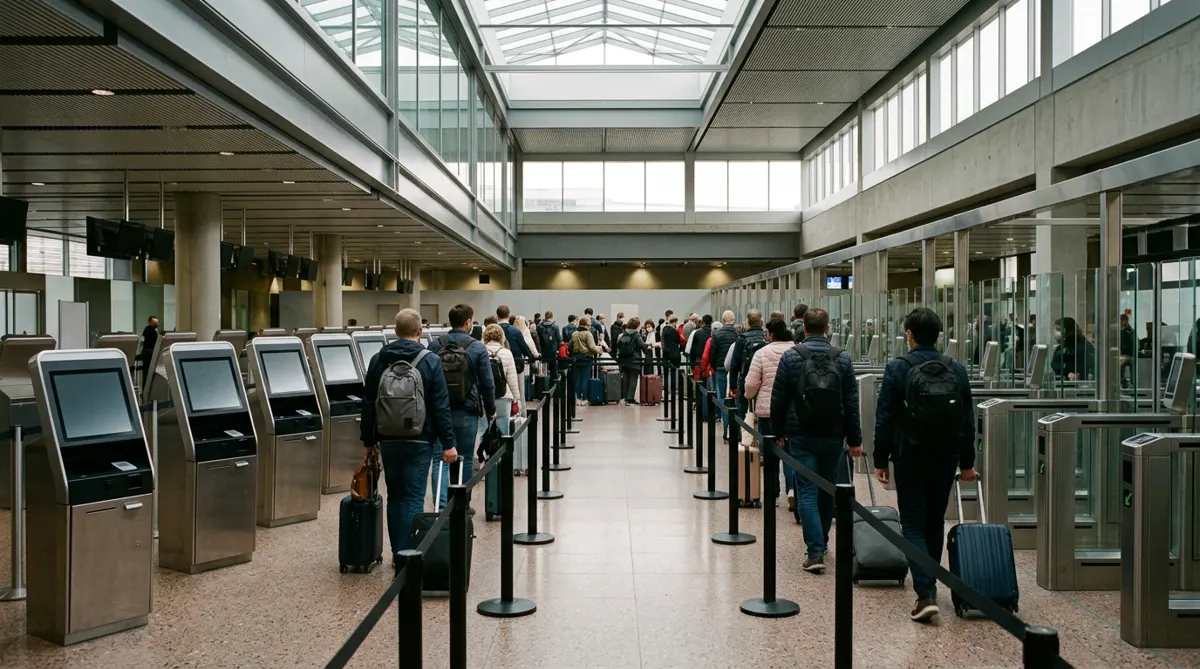
On your first crossing since EES started, passport control officers take a photo of your face and/or scan your fingerprints, and your passport is not stamped, according to the official How does the EES work page. On later crossings, officers only verify the fingerprints and photo already on file, which the EU says "will take less time".
Where a border has self-service kiosks, travelers with a biometric passport can register some data there first, but they still see an officer on a first registration. A non-biometric passport is still accepted; it just cannot be used at the kiosks (EES FAQ).
The EU's optional Travel to Europe app lets travelers with a biometric passport pre-register up to 72 hours before a crossing. As of the portal's latest version, it works when entering Sweden (passport data, facial image and the entry questionnaire) and Portugal (the entry questionnaire only). Other countries may add it later (Travel to Europe app page).

ETIAS: not yet, and no date
The official ETIAS website states that "ETIAS is currently not in operation and no applications for travel authorisations are collected at this point", and that the EU "will inform about the specific date for the start of ETIAS several months prior to its launch" (travel-europe.europa.eu/etias, page last edited 28 August 2026). An older EU news item still mentions a target of the last quarter of 2026, but the current ETIAS pages give no date.
When it does start, the EU says an ETIAS will:
- be needed by visa-exempt non-EU nationals visiting 30 European countries (the 29 EES countries plus Cyprus);
- cost EUR 20, with some travelers exempt from the fee;
- be valid for three years or until the passport expires, whichever comes first;
- be applied for on the official ETIAS website or the official ETIAS mobile app.
Source: What is ETIAS.
Watch out for unofficial sites. The EU warns that the official ETIAS website is travel-europe.europa.eu/etias and that it "does not issue authorisations nor licences to commercial intermediaries" (ETIAS news corner). Any site taking ETIAS payments today is not the EU.
UK ETA: required since 25 February 2026
The Home Office announced that from 25 February 2026 it became mandatory for visitors to hold digital permission to travel, and that airlines "will prevent passengers from boarding if they do not have an ETA, eVisa or have other valid documentation". At that date it covered visitors of 85 nationalities, including the United States, Canada and France.
- Who needs one: visitors who do not need a UK visa, which GOV.UK says usually means people "from Europe, the USA, Australia, Canada or certain other countries" (GOV.UK). EU citizens need one; Irish citizens do not.
- Who does not: British and Irish citizens (including dual citizens), UK visa holders, people with permission to live, work or study in the UK (including EU Settlement Scheme status), and visa-exempt nationals who live in Ireland and travel from Ireland, Guernsey, Jersey or the Isle of Man (When you do not need an ETA).
- Fee: £20 (GOV.UK). The fee rose from £16 to £20 under the Immigration, Nationality and Passports (Fees) (Amendment) Regulations 2026, in force from 8 April 2026. There is no refund once you apply.
- Validity: 2 years or until your passport expires, whichever is sooner, for as many visits of up to 6 months as you like.
- How to apply: on the official UK ETA app (Google Play or the App Store) or online at GOV.UK. GOV.UK warns that other websites may charge more and that you "cannot get a faster decision by applying through another website or app".
- How long: most decisions come within a day by email, but it can take up to 3 working days. You must not travel until the approval email arrives.
- Families: every traveler needs their own ETA, including babies and children.
- Transit: you need an ETA if you pass through UK border control to make a connection (landside). You do not need one if you stay airside without passing border control; check with your airline if unsure (GOV.UK).
Which applies to my trip?
- American, Canadian or Australian visiting Paris and London: EES registration when you enter the Schengen area, and a UK ETA before you travel to the UK. No ETIAS yet.
- UK citizen going to Spain or France: EES registration at the Schengen border, and no ETIAS yet. You never need a UK ETA: British citizens are exempt.
- EU citizen visiting London: a UK ETA. EES does not apply to you.
- Irish citizen: no UK ETA and no EES.

Staying connected
Two of these steps happen on a phone. The UK ETA app needs your phone's camera to scan your passport and your face, and the approval arrives by email, so a traveler applying at the last minute needs working data to apply and to watch for the decision. Without the approval, the airline will not board you. The EU's Travel to Europe app, where it is in use, is also a pre-registration you complete on your phone within 72 hours of the crossing.
A slow first EES registration can also eat into a tight connection. Having mobile data the moment you land lets you check your train or flight, rebook in the operator's app and message whoever is meeting you. See our Europe eSIM guide, the airport guides for London Heathrow, London Gatwick and Paris Charles de Gaulle, and check first that your phone supports eSIM. A travel eSIM is data only: it gives you mobile internet, not a local phone number.
Compare our Europe eSIM plans and install one before you fly.
FAQ
Do I need ETIAS to travel to Europe in 2026?
No. On 8 October 2026 ETIAS is not in operation and the EU collects no applications. The EU says it will announce the start date several months before launch.
Is EES the same as ETIAS?
No. EES is a biometric registration done at the border by passport control, live since 10 April 2026, with nothing to apply for in advance. ETIAS is a paid online authorisation you will apply for before travel, and it has not started.
Do EU citizens need a UK ETA?
Yes. EU citizens visiting the UK without a visa or UK status need an ETA, which costs £20 and lasts 2 years or until the passport expires. Irish citizens are exempt.
Do UK citizens have to give fingerprints at EU borders?
Yes, in most cases. UK nationals visiting the Schengen area for a short stay are registered in EES with four fingerprints and a facial image on their first crossing, unless an exemption such as a Withdrawal Agreement residence document applies.
How long does a UK ETA take to approve?
Usually within a day, often within minutes on the UK ETA app. GOV.UK says it can take up to 3 working days, so allow at least that long before you fly.
Do I need a UK ETA to change planes at Heathrow?
Only if you pass through UK border control. Passengers who stay airside without going through border control do not need an ETA; check with your airline if you are unsure.
Facts checked on 8 October 2026 against the European Commission (home-affairs.ec.europa.eu), the EU Travel to Europe portal (travel-europe.europa.eu, EES and ETIAS sections), GOV.UK and legislation.gov.uk. ETIAS has no start date yet, so check the official ETIAS site before any trip booked for 2027.