
Last updated: 22 October 2026
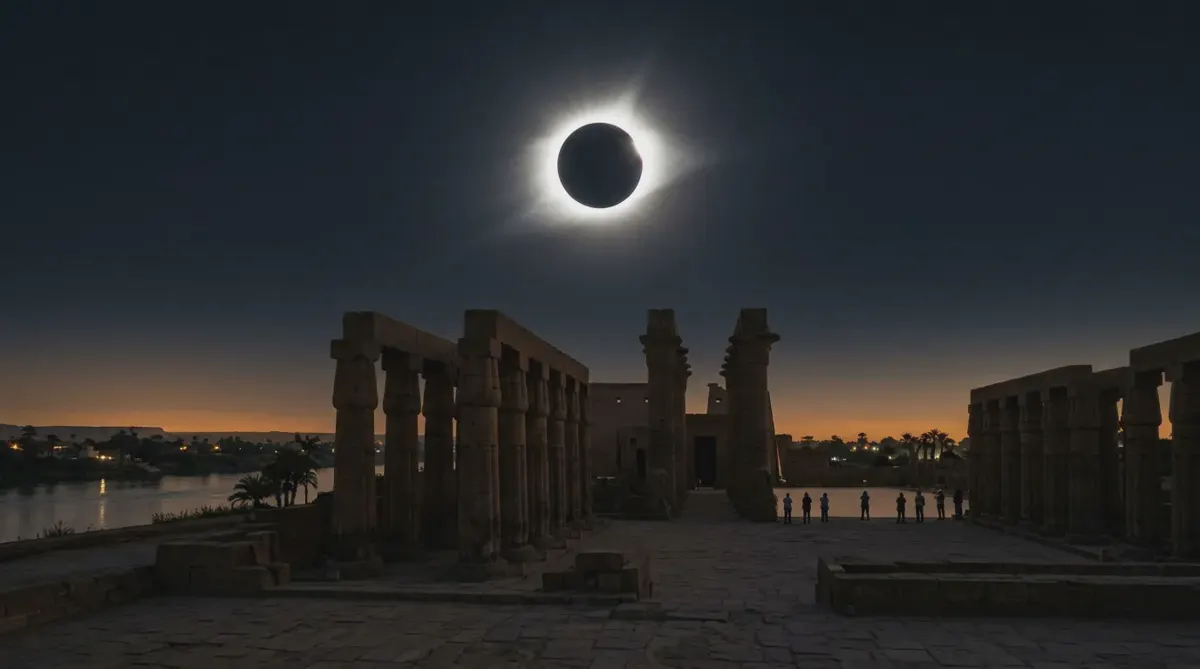
The total solar eclipse of Monday 2 August 2027 crosses the Strait of Gibraltar, the far south of Spain, northern Morocco, Algeria, Tunisia, Libya, Egypt, Saudi Arabia, Yemen and Somalia. Totality lasts up to 6 minutes 23 seconds, the longest over land between 1991 and 2114, and Luxor in Egypt gets about 6 minutes 21 seconds of it. In Spain you get 2 to almost 5 minutes, depending on how close to the Strait you stand.
Where to watch: times and durations by city
Totality is only visible inside a band about 230 to 260 km wide. A few kilometers outside it you see a deep partial eclipse and the sky never goes dark, so check your exact spot, not just the city.
| Where | Totality starts (local time) | Totality lasts | Sun height |
|---|---|---|---|
| Cádiz, Spain | 10:45 | 2 min 54 s | 37° |
| Tarifa, Spain | 10:45 | 4 min 39 s | 38° |
| Gibraltar | 10:45 | 4 min 27 s | 38° |
| Marbella, Spain | 10:47 | 3 min 18 s | 39° |
| Málaga, Spain (city center) | 10:48 | 1 min 52 s | 39° |
| Cabo de Gata, Almería, Spain | 10:51 | 2 min 06 s | 42° |
| Tangier, Morocco | 09:45 | 4 min 50 s | 38° |
| Tetouan, Morocco | 09:45 | 4 min 51 s | 38° |
| Oran, Algeria | 09:51 | 5 min 08 s | 43° |
| Sfax, Tunisia | 10:09 | 5 min 40 s | 55° |
| Benghazi, Libya | 11:28 | 6 min 09 s | 68° |
| Luxor, Egypt | 13:02 | 6 min 21 s | 82° |
| Marsa Alam, Egypt | 13:08 | 5 min 30 s | 81° |
| Jeddah, Saudi Arabia | 13:22 | 5 min 59 s | 76° |
Local times are summer time: UTC+2 in Spain, Gibraltar and Libya, UTC+1 in Morocco, Algeria and Tunisia, UTC+3 in Egypt and Saudi Arabia. We computed each line from NASA's published Besselian elements for this eclipse and checked the method against NASA's own central line table, which it matches to within a second. The edge of the moon is not smooth, so expect a few seconds either way, and more near the edges of the path.
Close, but no totality: Seville, Granada, Madrid, Rabat, Fez, Algiers, Tunis, Cairo, Hurghada, Aswan and Medina are all outside the path. Almería city sits right on the northern edge: drive east to Cabo de Gata to be sure. Seville gets a deep partial eclipse, and you will still need eclipse glasses the whole time.
The greatest eclipse falls just southeast of Luxor at 10:06 UTC (13:06 in Egypt), with the sun almost overhead at 82°, according to NASA. The longest totality on the whole track, 6 minutes 23.2 seconds, is in the desert of western Egypt, northwest of Luxor.
Spain and Gibraltar: shortest totality, easiest trip
Southern Spain is the easiest place to reach on the whole track, and the busiest. The best durations are along the Strait: Tarifa, Algeciras, Barbate and Gibraltar get between 4 and almost 5 minutes, Cádiz about 3, Marbella a little over 3. Málaga is near the northern edge, so the beaches west of the city get longer than the old town.
Booking is already tight. Euronews reported on 20 August 2026 that easyJet had recorded a 70% boost in bookings among British travelers to destinations on the path of totality. In the same report, a Booking.com search for three nights in Seville from 1 August 2027 showed 87% of places to stay unavailable, and 98% in Gibraltar. Seville is outside the path, so people staying there will drive south on eclipse morning: expect heavy traffic toward Cádiz and Tarifa.
Weather: good odds inland. Jay Anderson, the eclipse climatologist behind Eclipsophile, puts average cloud inland below 15% and calls inland Spanish sites "excellent eclipse havens". The risk is on the coast: Atlantic low cloud, and when the easterly Levante blows, stratus piling up against the Strait and a banner of cloud off the Rock of Gibraltar. In the satellite record, Cádiz saw the sun on 88% of days around this date, and Tarifa and Barbate on about 74%. Have a car and a plan B a few kilometers inland.
US phones in Spain: Verizon TravelPass and the AT&T International Day Pass both cost $12 a day per line. Our guide to whether your phone will work in Spain has every carrier's rate. Our Europe plan covers Spain, and eSIM for Europe explains how one plan works across borders. Gibraltar is not in our Europe plan: if you watch from the Rock, phones near the frontier can latch on to a Gibraltar network, so set your network selection to a Spanish operator, or take a global plan that lists Gibraltar.
Morocco: Tangier and Tetouan
Northern Morocco is a short ferry from Tarifa or Algeciras and gets almost 5 minutes of totality, more than anywhere in Spain. Totality starts at about 09:45 Moroccan time, so stay the night before.
Eclipsophile's advice for the weather: on the Atlantic side near Asilah and Larache, marine fog can linger past totality; Tangier is often protected by the high ground of Cape Spartel, with the eastern parts of the city and the beaches on the Bay of Tangier recommended. It suggests avoiding the Mediterranean coast between Tetouan and El Jebha on eclipse day, and names the eastern side of Tetouan as a good compromise.
Morocco is outside the US carriers' cheap zones and outside most UK plans' European roaming. Our Morocco page lists the plans that cover it.
Egypt: the longest totality, and the heat
Luxor is the classic choice: about 6 minutes 21 seconds of totality around Karnak and the Valley of the Kings, with the sun almost straight overhead. Sohag gets about 6 minutes 22 seconds. Eclipsophile's satellite record shows very little August cloud anywhere on the Egyptian part of the track, and it picks the Western Desert oases of Siwa and Bahariya as the safest bets of all.
The catch is heat. Eclipsophile gives Luxor's average high on 2 August as 42.0°C (108°F), with a record of 46°C (115°F). Plan shade, water, and a way to keep your phone and camera out of the sun: a phone in direct sun at those temperatures can shut itself down to cool off just before totality.
Our Egypt eSIM guide compares five providers, and covers app call restrictions and the phone customs rule.
Algeria, Tunisia, Saudi Arabia, Libya, Yemen and Somalia
- Algeria: Oran gets about 5 minutes 8 seconds. Eclipsophile says "promising eclipse weather can be found at most sites"; Algiers is just outside the path.
- Tunisia: Sfax gets about 5 minutes 40 seconds and has the lowest average cloud on the western part of the track, according to Eclipsophile. Tunis, Sousse and Monastir are outside the path.
- Saudi Arabia: Jeddah gets about 6 minutes, Abha about 6 minutes 3 seconds. Dust is the main risk on this stretch. We sell Saudi Arabia plans too.
- Libya, Yemen and Somalia: Benghazi is on the path with about 6 minutes 9 seconds, but the US State Department's advice for all three countries was Level 4, Do Not Travel, when we checked. Read travel.state.gov or your own government's advice before you consider them.
Eclipse cruises
Ships can move to dodge cloud, which is their main advantage. Sailings announced for 2 August 2027 include Seabourn Ovation in the Mediterranean, Carnival Sunshine on a 10-night cruise from Barcelona leaving 25 July, Celebrity Xcel from Barcelona on 31 July, Celebrity Ascent from Civitavecchia on 26 July, Ponant's Le Boréal from Lisbon on 30 July (a Smithsonian charter), and Ambassador's Ambition from Dundee on 27 July, due at Gibraltar on eclipse day. Check the line's own page for the itinerary and how it will position the ship. A travel eSIM works in port and near the coast, never on the ship's own network at sea: see eSIM for a cruise.
Eye safety
- Look at the partial phases only through eclipse glasses or a handheld solar viewer that meets the ISO 12312-2 standard, bought from a supplier on the American Astronomical Society's list of reputable vendors. Ordinary sunglasses are not enough.
- Take the glasses off only once the sun is completely covered, and put them back on the moment the first bright point of sunlight returns.
- Outside the path (Seville, Cairo, Algiers) there is no safe moment without protection.
- Never point a camera, binoculars or a telescope at the sun without a solar filter on the front, even with glasses on. A phone can photograph totality itself without a filter; for the partial phases, hold a glasses lens over the camera.
Staying online on eclipse day
On the day, thousands of people will be in the same few towns, all checking cloud forecasts, maps and traffic at once, and sharing videos straight after. Local networks slow down in crowds like that, but having a data plan of your own beats hunting for café Wi-Fi in a town you drove into at dawn.
- Download offline maps of the whole area the night before, with two or three backup viewing spots.
- Save your tickets, ferry bookings and hotel addresses to the phone.
- Install the eSIM at home before you fly, and turn on data roaming for the eSIM line only. The days of a plan start when it first connects in a covered country, and each plan says its rule before you pay.
- A phone holds several eSIMs: a trip from Spain to Morocco can carry a Europe plan and a plan that covers Morocco side by side, and you switch between them in settings.
Our Egypt plan with 1.5 GB a day costs $8.99 for 7 days, and unlimited data for 7 days is $15.99. In Spain, our Europe plan with 1.5 GB a day costs $11.99 for 7 days, or $19.99 for 7 days unlimited. In Morocco, our global plan with 1.5 GB a day costs $17.99 for 7 days. Prices as of 22 October 2026; the plan pages always show the current ones.
FAQ
When is the 2027 solar eclipse?
Monday 2 August 2027. Totality starts at about 10:45 in southern Spain, 09:45 in northern Morocco and 13:02 in Luxor, local time. The whole eclipse, from the first bite out of the sun to the last, lasts about 2 hours 20 minutes in Spain and Morocco and about 2 hours 45 minutes in Luxor.
Where is the path of the 2027 total solar eclipse?
It runs from the Atlantic across the Strait of Gibraltar, the far south of Spain (Cádiz, Tarifa, Gibraltar, Marbella, Málaga), northern Morocco (Tangier, Tetouan), northern Algeria, Tunisia, Libya, Egypt (Luxor), Saudi Arabia (Jeddah), Yemen and Somalia, then out over the Indian Ocean.
How long is the longest solar eclipse of 2027?
The maximum is 6 minutes 23.2 seconds, in the desert of western Egypt, according to NASA. Luxor gets about 6 minutes 21 seconds. It is the longest totality over land between 1991 and 2114.
Can you see the 2027 solar eclipse in Spain?
Yes, as a total eclipse in the far south: about 4 minutes 39 seconds in Tarifa, 4 minutes 27 seconds in Gibraltar, 2 minutes 54 seconds in Cádiz and under 2 minutes in central Málaga. Seville, Granada and Madrid see only a partial eclipse.
Can you see the 2027 solar eclipse in Egypt?
Yes, and Egypt has the longest totality on the path. Luxor gets about 6 minutes 21 seconds starting at 13:02 local time, with the sun almost overhead and very low odds of cloud. Cairo, Hurghada and Aswan are just outside the path.
Will I need eclipse glasses during totality?
No, only during the partial phases before and after. Take ISO 12312-2 glasses off when the sun is fully covered and put them back on the moment it starts to reappear. If you are outside the path, keep them on throughout.
Facts checked on 22 October 2026 against NASA's Besselian elements, path table and greatest eclipse data for the 2 August 2027 eclipse (eclipse.gsfc.nasa.gov, Fred Espenak), the EclipseWise summary of the same eclipse, Jay Anderson's Eclipsophile climatology for the 2027 track, Euronews (20 August 2026) for the easyJet and Booking.com figures, cruise line announcements as reported by Afar and CruiseMapper, the American Astronomical Society's eye safety guidance, our own Spain, Egypt and US carrier guides, and our plan prices on 22 October 2026.