
Last updated: 20 October 2026
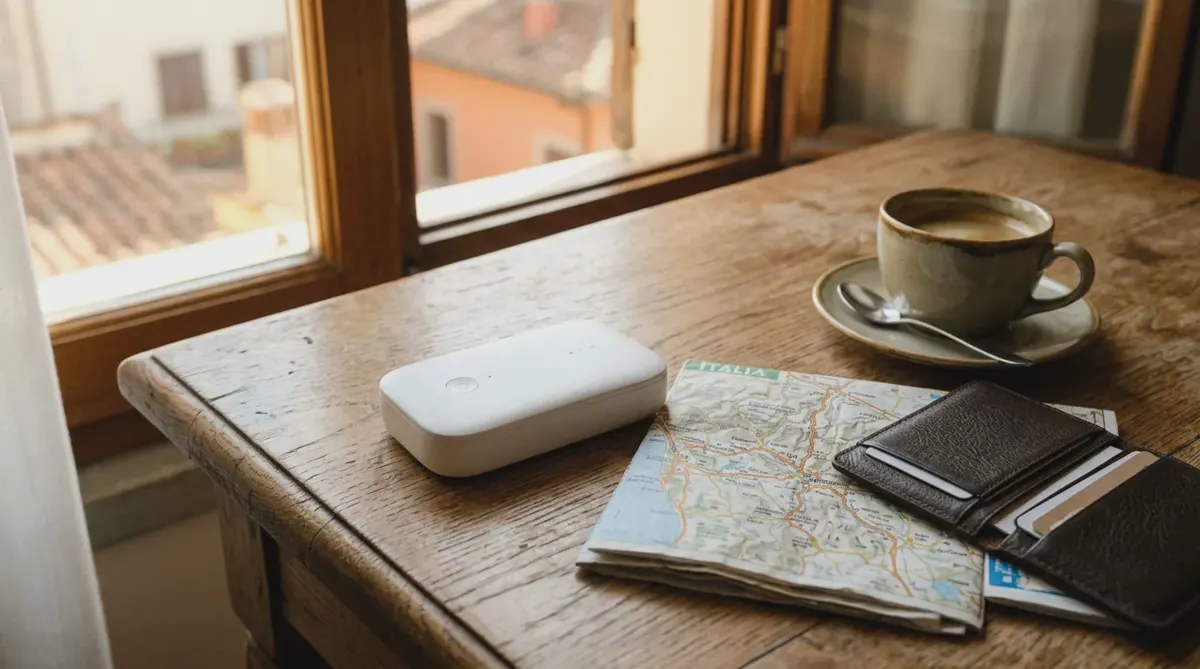
A pocket WiFi is a small battery-powered hotspot with its own SIM that shares mobile data with your phone, laptop and tablet over WiFi. It still works abroad, and for a group sharing one connection it can be the cheapest option. For most travelers, though, a travel eSIM on the phone does the same job with nothing to rent, carry, charge or return, and your phone's own personal hotspot can share it with a laptop or a travel partner.
Our Global eSIM covers 170 countries from $17.99 for 7 days with 1.5 GB a day, and our Europe eSIM costs $11.99 for 7 days.
Three ways to get WiFi on the go abroad
| Rent a pocket WiFi | Buy your own travel hotspot | Travel eSIM + your phone's hotspot | |
|---|---|---|---|
| What you pay | A daily rental fee, often plus delivery or insurance | The device, then data top-ups for each trip | One plan per phone, nothing else |
| Setup | Order ahead, collect at the airport or hotel, return by post or at a counter | Buy once, top up before each trip | Install on the phone before you fly |
| Devices | Several phones, laptops and tablets at once | Several devices at once | Each phone on its own plan; share it with the phone's hotspot |
| Works if you split up | Only near the device | Only near the device | Yes, each phone is independent |
| Battery | The device's, plus your phone's | The device's, plus your phone's | Your phone's (hotspot drains it faster) |
| Lose it or forget to return it | Late, loss or damage fees | You lose the device | Nothing to lose |
| Needs an eSIM-ready, unlocked phone | No | No | Yes |
Renting a pocket WiFi
Rentals are most common for Japan and Korea, where companies deliver to your hotel or let you collect the device at the airport. Japan Wireless, for example, lists its unlimited pocket WiFi from US$4.70 a day on its home page (checked on 20 October 2026), with a free prepaid return envelope and optional device protection at an extra cost. A replacement fee applies if you lose or damage the device without protection. Prices vary by country, company and trip length, so compare the daily fee times your days, plus delivery and insurance, before you book.
Buying your own travel hotspot
Global hotspot devices with their own data store are sold by several brands. You buy the device once, then buy data for each trip. It suits frequent travelers who carry laptops, but the device cost is upfront and you still carry, charge and keep track of one more thing. Check the coverage list for every country on your route before you buy data.
A travel eSIM and your phone's hotspot
An eSIM puts the data plan on your phone. Install it at home on WiFi, switch it on when you land, and your usual number stays on for calls and texts. To connect a laptop or a travel partner, turn on your phone's personal hotspot. Most travel plans allow it, but some limit hotspot use, so check the plan details, and expect your phone's battery to drain faster. How to set up your phone's hotspot on a travel eSIM: eSIM hotspot.
If your phone takes no eSIM, a pocket WiFi or a physical travel SIM is the way to go: see my phone doesn't support eSIM and travel SIM card or eSIM.
What a family of four pays for 10 days
Each person on their own eSIM, with 1.5 GB a day each:
| Trip | Four eSIMs | One rented pocket WiFi |
|---|---|---|
| 10 days in Europe | 4 × $19.99 (15-day plan) = $79.96 | Compare the rental's daily fee × 10, plus delivery and insurance |
| 10 days in Japan | 4 × $17.99 (15-day plan) = $71.96 | From about $47 at Japan Wireless's US$4.70 a day, plus device protection if you take it |
For a family that stays together, a rented pocket WiFi can cost less, as in Japan above. Four eSIMs win when you split up during the day, when teenagers go their own way, or when you would rather not carry and charge one shared device. A middle way: one or two eSIMs, shared over the phone's hotspot when you are together.
When a pocket WiFi still makes sense
- A group or family that stays together and wants one connection for many devices.
- Phones without eSIM, or phones locked to a carrier: check yours and whether it is unlocked.
- Laptops and tablets without a SIM, for remote work all day, where a dedicated device saves your phone's battery.
For Japan specifically, with its rental counters and hotel delivery, see eSIM vs pocket WiFi in Japan.
When an eSIM is the better choice
- You travel alone or as a couple.
- You split up during the day or travel between cities at different times.
- You land late, or would rather not queue at a counter or post a device back.
- You want nothing extra to charge, carry, lose or return.
For the four ways to get data abroad side by side, carrier passes included, see the best international phone plan for travel. For trips across several regions, see global vs regional eSIM plans.
FAQ
Is pocket WiFi still worth it?
For a group or family that stays together, or for phones without eSIM, yes: one device can connect many phones, laptops and tablets. For solo travelers and couples with recent phones, a travel eSIM usually does the same job with nothing to rent, carry or return.
Do pocket WiFi devices really work?
Yes. A pocket WiFi connects to a local mobile network like a phone does and shares that connection over WiFi. Speed depends on the network it uses and how many devices share it, and it only works when you are near the device.
Do I have to pay monthly for portable WiFi?
Not for travel rentals: you pay per day or per trip. A hotspot you buy yourself has an upfront device cost, then you buy data for each trip or by subscription, depending on the brand.
Is a pocket WiFi better than an eSIM?
It depends on who travels. A pocket WiFi suits a group that stays together or phones without eSIM. An eSIM suits solo travelers and couples, people who split up during the day, and anyone who does not want another device to charge and return.
Can I share an eSIM's data with my family?
Yes, with your phone's personal hotspot: your family's phones connect to yours over WiFi. Most travel plans allow hotspot use, but some limit it, so check the plan details. It drains your battery faster and only works while you are together.
Facts checked on 20 October 2026 against our catalogue (Europe, Global 170 and Japan plans) and Japan Wireless's home page for its rental price. Rental prices change: check the company's own rates before you book.